The reason for LED lamp market dilemma?

One problem: there is no real openning market

As we all know, because of insufficient penetration of LED lamp market, the public to the LED Lights has been in a stranger. Although some companies in the industry is the leading brand within the industry. However, first-class brand to get consumers in the market really agree with and trust of the public seemed to have never seen. The eyes of the entire industry to market has always been on a test the water of the hotel, shopping malls goals and national mandatory bidding poor small-scale projects.

We all see that, huge market cake only have a trace of smal share of the points. The swarm of LED Street Light companies head long into this narrow space, desperately hoping to grab and cheap runs.  It is not difficult to see that all the them driven to the wall, no positive sign of industrial market. The vast LED lamp market is secretly laughing at the side.

Second Problem: marketing efforts far not in place

LED industry sales model has been too independent on the traditional dealer channel, an irreversible emerging power of fresh forces are creeping up. They are the professional managers.

“See rabbits not spread eagle”, the market is still being in the range of tepid. Because the narrow eyes and professional degree is not enough, traditional dealers keep established in onimmediate gains and losses and the current interest. In the face of the ooperating costs and other costs of store, the dealers have the time and effort to advocate the business of the main products. How many professionalism for the people who are accustomed to wait and see. In fact, it seems also reasonable. Dealers will not be the real push hands for the LED lamp market. When the market have truly effective and quick start, the dealers who lack of long-term vision are bound to rush into mass action. Thus, the future of the LED High Bay market is bound to repeat the mistakes of the traditional lighting industry,  the situation in the industry as a whole turn will  turn into a vicious circle and disorderly the chaotic situation. Therefore, The hope and future of the LED can not be pinned on the top of traditional distributors.

 

Different cooling materials for LED lamps (2)

In previous sections, we discussed two different cooling materials for LED lamps: porous structured ceramic and conductive plastics. But none of them are available for practical uses. In next section, we are going to introduce the final cooling material, see if it is suitable for LED lamps.


Graphite material: due to its special molecular structure, graphite material has a property of anisotropic heat transmission. Graphite has a layer structure, covalent bond structure within each layer and molecular bond structure between layers. The internal-layer construction is compact, having stronger heat radiation ability, while the inter-layers construction is incompact, the heat transmission speed is much lower than internal-layer.


In previous sections, we discussed two different cooling materials for LED lamps: porous structured ceramic and conductive plastics.


According to its special internal construction, designers usually cut graphite into sheet structure when used as radiators due to its high heat radiation ability in lateral. However, those transmitted heat will be gathered on the side surfaces. How to radiate this part of heat into air is the key potion. Designers have to increase the area of side surfaces, and meanwhile make sure that the middle transversal surface lower than a threshold to maintain the lateral heat radiation ability. Therefore, designers create an approximate cone structure. Although this conical graphite radiator has a very good heat radiation capability, it is unfeasible in practice since that they need a lot of space. The current used graphite radiators in the LED Street Light market are sheet-shaped. They actually just transmit all the heat from middle to both sides. How to radiate the heat on side surfaces is a big problem. After a series of tests, the cooling capability of graphite plate in amazing, even better than aluminum plate. However, they can only maintain this well behavior in a short term. As time passes, their performance will get worse and worse. After ten hours, the heat radiation capability will drop to 30%. Sales of this kind of radiator are not good. In near future, they will be probably disappeared just like porous structured ceramic and conductive plastics did.


So far, aluminum plates are the most commonly used cooling materials for LED lights. No matter how many other materials were created or are creating, for a quite long time, we believe that aluminum will still be the main material for radiators.

13 watt led bulb prices decline in March, which slowed down in some areas rebound

LED High Bay inside survey shows that the retail prices  in March of this year does not continue a steady downward trend like the last two quarters. The price to replace 40W LED bulb with 13 watt led bulb is about 7%,the main place is Japan and the United Kongdom. Replace 60-watt LED bulbs in March prices showed 1.6% fell slightly,the average international price of $ 33.

Beside the US, in March 2012, the global price of basic stop faliing in some areas even more substantial rebound. In addition to the exchange rate and other objective factors,  the main reason for the new expensive products on the market is the prices.

To replace the traditional 40W LED bulb, the international average price in March rebounded to about $ 21, mainly due to new product performance led to price increase of 13 watt led bulb, such as full beam emitting angle of the design and sensing. The UK in February has large price changes, average price to replace 40-watt LED Street Light bulbs is more than 30 U.S. dollars, mainly due to the old low-quality items out of the market, while the new items luminous efficiency or beam design leading to higher prices. Furthermore, in addition to other parts of Japan currencies against the U.S. dollar exchange rate fell, resulting in the conversion price relative rising. In South Korea and Germany rose 5% and 6%, respectively, only the U.S. prices continued the downward trend, a decrease of about 2%.

To replace the traditional 60W LED bulbs with 13 watt led bulb, the international average prices continue to fall in March. But slow speed, a drop of only 1.6%. The United States market competition, the decline price is very obvious. The average price has reached 25.6 dollars,  the most price advantages region.  Japan area has no significant change, but because the upgrading of Japan yen exchange rate is eventually resulting in the downslow prices. In addition, South Korea and the United Kingdom in March, the prices were up slightly. Mainly due to the falling exchange rate and the slightly reducing down of the commodity prices.

The United States to replace the 40 watt and 60 watt LED bulb price dropped sharply. The LED light bulb which need to replace 40W lighting fell 19%, the average price has fallen below $ 20, came to $ 18.

Different cooling materials for LED lamps (1)

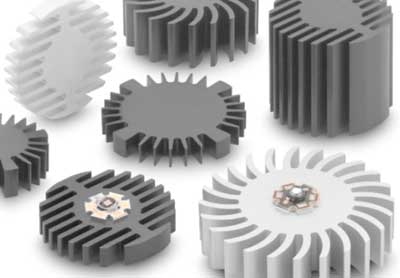
The commonly used cooling material for electric devices is aluminum. In some special cases, copper is also used, like CPU. Copper better than aluminum in capacity of heat-transmission but worse in capability of heat radiation. Compare two radiators with same construction but made by different materials, radiator made by aluminum are better in natural cooling. However, if cooling fans are taken into account, the result is opposite. Recently, a lot of LED manufacturers tend to introduce ceramic, conductive plastics and graphite material into their LED cooling technique. What are the particular performances of these new cooling materials for LED lamps?


The commonly used cooling material for electric devices is aluminum. In some special cases, copper is also used, like CPU. Copper better than aluminum in capacity of heat-transmission but worse in capability of heat radiation.


Ceramic: the firstly used cooling material is a type of ceramic with porous structure. The original purpose of this radiator is to raise the coefficient of heat transfer by increasing the surface area. In fact, this method is infeasible. The real thermal conductivity of this radiator is only 15 W/(m oC), even lower than alumina (a commonly use ceramic material for cooling technique). Thermal effect of it is much worse than the aluminum plate. Thus this oldest ceramic cooling material exited for a very short time and disappeared thoroughly.


Conductive plastics: this is a new LED Street Light cooling material turned up in recent years. If you study specifications of this material, you will find it has a very low thermal conductivity (only 15 W/(m oC)). Some plastics have better capabilities of surface heat radiation than aluminum. However, tests results indicated that this cooling material is only suitable for low powered LED lamps. They have very similar working effects with aluminum alloy when used in low powered LED lamps (lower than 2W). For high powered LED lamps, the cooling efficiency is even worse than the material mentioned before. The final temperature of LED PN junctions for a 6W LED Spot Lights (using this type material as radiator) is up to 92 oC. Although some plastics have good capability of heat radiation, but thermal conductivity of them is too low. They absorb those heat generated by LED chips in a very slow rate. If the heat generated by LED chips dramatically exceeds their digestion, they will lose the cooling function completely. Similar to porous structured ceramic, conductive plastics did not exist very long in LED lighting market.


These two cooling materials for LED lamps are not competent. In next section, we are going to discuss the performance of graphite material.

wholesale led bulb for led’s future

According to Display Search research,  LED lighting demand will be continued growth in these coming years, also for the wholesale led bulb.
According to DisplaySearch’s latest Quarterly LED supply / demand market forecast report, a variety of market indicators, LED applications, it is expected that the lighting leading the way to 20% in 2010. In 2014, the overall income of the backlight and lighting is expected to be $ 7.2 billion increase from 2010 to $ 12.7 billion. The high demand for LED high bay lighting is the main driving force for this growth.
Fortunately, suppliers have already noted that these trends, and as early as ready to expand production capacity. DisplaySearch predicts the global LED production capacity will reach 227 0 billions in 2013.

wholesale led bulb for led's future
LED-backlit LCD TV in the fourth quarter of 2010, the first quarter of 2011 and the beginning of the second quarter of 2011, high inventory and low sales, resulting in a slight decrease of demand for LED backlighting; We believe that due to seasonal demand, it pick up again, and reaches its maximum in the third quarter of 2011. wholesale led bulb also the same future.

Regional market forecasts of LED lighting Japan in 2011 the world’s largest LED lighting market this year, the country’s market share of 63% in 2011 woulbe be  40% in 2014. Japan’s high investment in LED lighting, mainly due to the efforts of the country’s power shortage and energy-saving energy. Until 2014 will remain the world’s largest LED Street Light lighting market, 2011-2014, the growth rate of the LED lamps in China, North America and Europe will be higher than in other regions. wholesale led bulb would be sold very good in China.

In 2010, South Korea is the world’s largest LED supplier, in 2011, Taiwan get the first place. In 2011, chip size 500×500 of the top three suppliers were the S-LED, LGIT and Epistar, Due to substantial investment in the LED production,  Mainland China has become the biggest dark horse LED supply.
With the rapid growth of the market in the next few years, the price advantage and the right strategy LED suppliers will face a very big challenge. 2011 investment in LED lighting in full swing, excess capacity would increase competition and lead to price fell sharply.

wholesale led grow lights in LED Tunnel Lights

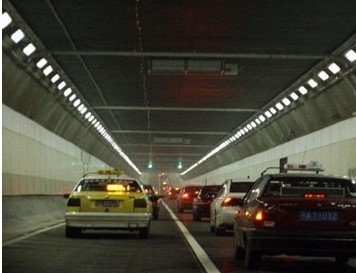
With the growing number of projects of the tunnel, the tunnel construction play an increasingly important role in modern transportation. The tunnel is for a closed space, which natural light can not be irradiated,  in order to ensure continuity and vehicular driving safety of human life, even during the day inside the whole need of artificial lighting, tunnel lighting is an integral part of the tunnel construction. Then what about wholesale led grow lights?

The tunnel lighting is different from the general lighting of the road, with its distinct specificity, and safety considerations are particularly important in the lighting system. Human adaptation and dark adaptation factor should be taken into account in the design of tunnel lighting program, attach importance to the transition section and transition section of lighting design.  The exit of the tunnel due to the adaptation time is very short, usually in less than 1s, so do other processing. I think wholesale led grow lights are the same concept.


wholesale led grow lights in LED Tunnel Lights

The general tunnel visual problems of the following:

(1) before entering the tunnel (daytime): great brightness difference of inside and outside of the tunnel, so to see from the tunnel external lighting is very full of the tunnel entrance will see the “black hole” phenomenon.
(2) After entering the tunnel (daytime): Automotive by bright external to enter even if not very dark tunnel, after a certain period of time to see the inside of the tunnel, known as “adaptive lag” phenomenon.
(3) exit of the tunnel: during the day, the vehicle through a long tunnel near the exit, due to the external brightness high to see through the export, the export appears to be a “white hole”, there will be a strong glare, the driver will not feel; night and day on the contrary, see the exit of the tunnel is not a bright hole, but the black hole, so that the driver not see the external road linear and obstructions.wholesale led grow lights are also the same such as LED high bay.

In the daytime, the lighting brightness of the tunnel exit and entrance lighting levels should be higher than the tunnel lighting luminance values; at night, on the contrary, it should be less than the tunnel lighting brightness value, when the street lighting in the tunnels, The surface brightness values ​​within the tunnel shall not be less than 2 times the outdoor brightness values.