
Resolutions for LED tube drivers

Presently, more and more LED lighting products are used in our daily lives, from outdoor lighting applications to indoor lighting applications. LED is new developed technique which is more environmental friendly, more durable, more easily to control and of course can save more energy. LED tube is one of the most widely used indoor LED lighting products.
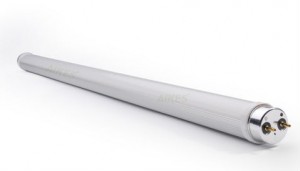
Presently, more and more LED lighting products are used in our daily lives, from outdoor lighting applications to indoor lighting applications.

LED tubes drivers can be divided into two types: isolated drivers and non-isolated drivers.


The input and the output of an isolated driver are “blocked” by transformers. These transformers can improve the security of the entire device but reduce the efficiency (around 85%) as well. Another disadvantage is that these transformers are too large to be put into the limited space within LED tubes.


Different from isolated drivers, the input and the output of non-isolated drivers are connected directly by circuits. Although these drivers are more efficient, they are somehow life-threatened. Currently, the most commonly used LED tube drivers are non-isolated BUCK drivers: convert AC to DC through rectifiers and meanwhile drop voltages through Buck block to maintain a constant current.


These improved drivers are much simpler in circuit design, smaller than isolated drivers. The normal efficiency of them is 80% ~ 90%. One can support more than 100 LEDs (in cascade or in parallel or both). However, these LED tube drivers have their own defects. Since non-isolated drivers will introduce the high energy from input to output, risking user’s live. To solve this problem, an insulated PCB will be inserted between AC input and aluminum cover. This design can block as high as 2000V voltage, even so it cannot pass the CE Certificate.


Comprehensively, both of isolated drivers and non-isolated drivers have their own advantages and disadvantages. Non-isolated drivers think more of efficiency, reducing energy consumption; while isolated drivers are safer to use. In fact, most people intend to use isolated drivers due to their small sizes, high efficiencies, low costs, more cost-effective.


LED tube drives can be divided into internal drivers and external drivers. LED tubes using internal drivers can directly replace the traditional fluorescent tubes without any changes. There are two different internal drivers: 1. Rectangular driver, installing within the aluminum shell. It is less practical due to the unevenly heat distribution. LED chips around the power supplier will continuously worked in high temperature. LED tubes using this kind of drivers usually have shorter service life. 2. Divide the entire power supplier into two parts and mounted separately on both sides of the tube. Because of the limited space of tube ends, design is more complicated.
 

How to choose right LED divers for your LED lighting applications

The load of LEDs impacts the reliability of drivers. The voltage-current characteristic of LEDs determines that within a certain region, with the increase of voltage, current will be exponentially raised. Therefore, many LED lamps driven by switching power suppliers worked in an unstable state. Since the output of switching power suppliers is a complex multiple harmonic waves rather than a constant value, leading to the inevitable fluctuation of the output signal.

 The load of LEDs impacts the reliability of drivers. The voltage-current characteristic of LEDs determines that within a certain region, with the increase of voltage, current will be exponentially raised.

As we all known, LED is very sensitive to voltage variations. Working under normal current, the voltage should be within the range of 0.3V-0.6V (different power consumptions may have slightly differences in voltages). Once working under unstable voltage, tiny changes can cause huge vibrations in current, and consequently the output power. Excess current may cause irrecoverable damages to LED Lights.


Facts proved that adding voltage-limited elements (like TVR, TVS) have little effect on reducing the current fluctuations. It seems that LED drivers were never as competent as other drivers. Reliability and efficiency are restricted with each other. Divers with higher efficiency must have a lower reliability, vise versa. The increase of reliability is at the cost of efficiency. In order to reduce the impact of input voltage to output voltage, energy must be converted through multiple levels.


In fact, all these problems were caused by LED loads. Recent years, experts put forward another proposal: to improve the internal connection of LED products to reduce the load. The simplest way is connecting resistors between LED chips. The larger the resistance, the more stable the load. Definitely, this method is still at the cost of efficiency. It is the simplest but not the best way. After this, some people introduced another resolution: adding linear barostats, using transistors as auto-adjusting elements. In this way, transistors are treated as changeable resistors. By doing so, the final circuit will be more stable and meanwhile efficiency can be guaranteed as well. This kind of LED drivers, to a large extent, is more advanced than that just simply insert resistors between LED chips. At present, the most commonly used method is constant-voltage sources combined with linear galvanostats. This method still provides very limited efficiency to the entire device.


Differences among LED, LED backlighting, OLED

At present, many companies played trick with concept of LED backlighting displays and LED displays. As a matter of fact, they are completely different applications. Another confusable LED technology is OLED. How to distinguish these three types of LED technologies?

 At present, many companies played trick with concept of LED backlighting displays and LED displays.

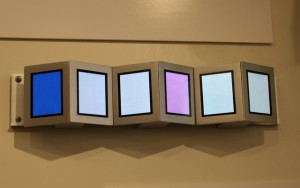
LED displays directly use LED Lights as pixel components. These LEDs will be arranged in matrix, sending out red/green/blue rays to comprise color screens. Thank to the “oversized” LED, the distance between pixels (known as dot pitches) of the same color is also oversized. In another word, LED displays are only suitable for large screens.


LED display is a combination of micro-electronic technology, computer technology and information processing, having many advantages: colorful, wide dynamic range, high light intensity, long service life, stable working condition, etc. Due to these advantages LED panel displays quickly became the most popular public media. Currently, LED displays have been widely used in many places: large plazas, commercial advertisements, stadiums, press releases, stock exchanges, etc.


LED backlighting displays just replace traditional CCFL backlighting source of LCDs with LEDs. LCDs working principles can be simplified as: liquid crystal molecules deflect under external voltage as small gate for lighting sources, changing the transmittance of rays. These rays then project on the different color filters to form a complete picture.


Backlighting module’s transformation from CCFL to LED brought a lot merits to LCDs: more evenly distributed light, less power consumptions, more fashioned appearance. However, the majority of LED backlighting displays on the market used White LEDs. These are no other changes except for lighting sources. The display effect of this kind of devices is much worse than that of RBG-LED displays. The later failed to widely spread in the market due to its high cost. Thus these White LED backlighting displays and LED Street Lights are essentially different from normal LED displays and cannot be considered as one thing. Nowadays, there are more than 100 research institutions and enterprises has involved into this area, including SAMSUNG, LG, Philips, Sony, etc.


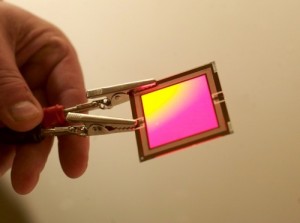
OLED is the abbreviation of Organic Light-Emitting Diode. As a matter of fact, the principle has been discovered in 1936. But until 1987, Kodak introduced a new OLED double-layer device. Since then, OLED has generally comes into our sight. OLED is a brand new flat panel display technology which can be commercialized.