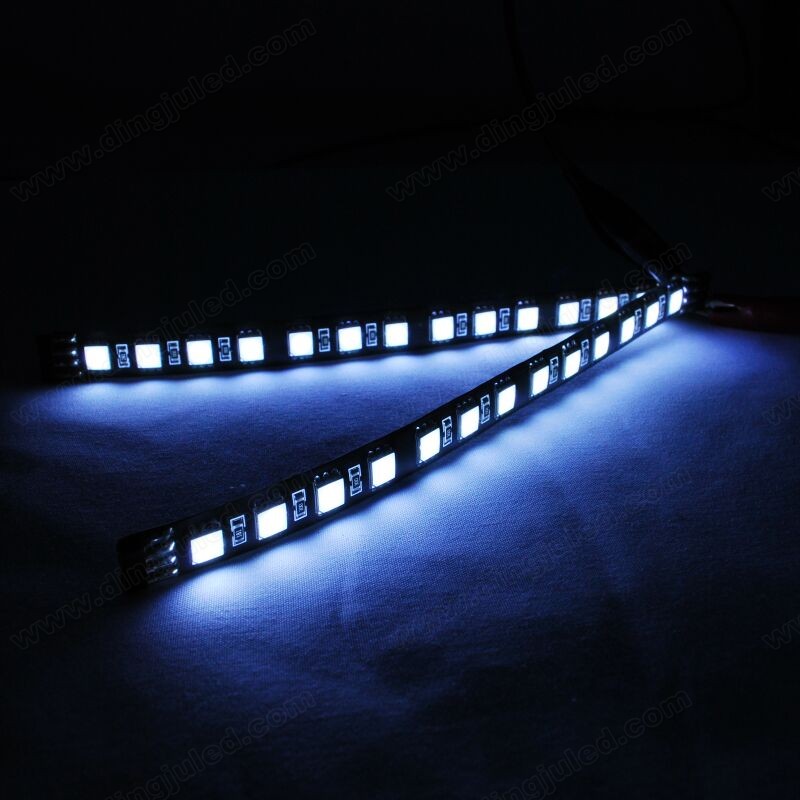
How to solve the cooling problem of soft LED bars?

1)       Circuit design. The commonly used input voltages of LED bars are 12VDC and 24VDC. Circuits worked under 12VDC are generally combinations of three series branches and multiple parallel branches, while circuit under 24VDC are combination of six series branches and multiple parallel branches. Since soft LED bars should be connected in series, the particular length of these bars all depends on the width of the circuit and the also the thickness of the copper foil. For the reason that the maximum current density per unit area is closed related to the cross section area (CSA), we have to take this point into account during the wiring. Otherwise, soft LED bars will work in overheated conditions due to excessive current. It is cleared that LED lighting products are not sustainable in constant high working temperatures. It will cause unrecoverable damages to circuits and meanwhile reduce the service life of LED lights chips.


1) Circuit design. The commonly used input voltages of LED bars are 12VDC and 24VDC.


2)       Problems in production process. Since LED bars used series-parallel connections, failure of one branch will increase the input voltage in other branches. Under such circumstance, LED grow lights will send out brighter light, but in the meantime, generate more heat. The clearest example is 5050 soft LED bars. Short circuit in any one of the branch of 5050 bars will double the working current in other branches (from 20mA to 40mA). Users may observe an instant and obvious light enhancing and all together sharply increased working temperature. Circuit may probably be burned up with several minutes in server cases. However this fault is relatively obscure than other problems and hardly be discovered. If testing technicians only concern about whether LED chips work (sending out light) but pay no attention on whether LED chips work in a normal state (sending out normal brightness light), branch short circuit would be frequently occurred. That is the reason why most LED bar producers frequently received feedback from customers complained that their products were overheated and over-bright with unknown reasons.

Solutions:

1)       Increase the distance between wires on circuits as much as possible. It is proved that the ideal condition is larger than 0.5mm. Increase the thickness of copper foils without violating the customers’ requests. General thickness should be 1-1.5 OZ.

2)       Avoid short circuit during the patch.

3)       Double check the patch location before switching on.

4)       Performing electrical testing after switching on. Measuring the light intensity gradually.

rgb led light controller and white led

In recent years, the industry began using LED lights to replace CCFL and EL as the LCD backlight (background light for short) compared to CCFL, EL. LED has the following advantages: 1) to make the LCD more realistic colors, LED backlight cho to provide 130% of the NTSC color scale, only 70% of CCFL. Levels expansion of the LCD image chroma saturation, and more realistic; to make the LCD thinner thickness in the 18-inch LCD module, LED backlight thickness is 4mm to 6mm in CCFL 8mm ~ 12nm; 3) long life, up to 50,000 hours; 4) meet the requirements of environmental protection, LED contains no mercury, 5) compared with EL backlight LED backlight does not arise from interference. Therefore, LED backlighting is widely used in PC, TV, car audio, mobile phones, communication devices, personal digital assistant (PDA) and watches, and other fields, it has become the leading products of the LCD backlighting market.

LED market demand in 2002 accounted for about 60% of the total market demand backlight, green, red, blue and white LED LCD backlight, due to price factors, the green LED Habitat mainstream, accounting for 80 of the LED backlight %. Their rated current of 2mA ~ 20mA, the brightness of 600mcd. Due to the higher cost of the white LED is mainly used for color mobile phones and color PDA’s backlighting and automotive instrument lighting.

2 white LED light-emitting mechanism and characteristics

rgb led light controller and white led


2.1 light-emitting mechanism

Single-chip white LED tube of CaN Containing InGaN active layer light-emitting diodes, it is mainly there are two light-emitting mechanism: one is the combination of blue LED and yellow phosphorus, the emission of yellow light through the blue and phosphorus mixed to produce white light; another is to produce white light through a combination of UV LED and red, blue, green and phosphorus.

2.2 Features

White LED main characteristics are: the forward voltage drop of 3.5 V; luminous efficiency greater than 20lm / W, better than incandescent bulbs, fluorescent second (601m / W ~~ 100lm / W), in 2004, the luminous efficiency can be increased 60lm / w, close to the fluorescent level, which is used extensively for the lighting market; luminous flux for the 231m; small package size. SMD-type white LED Nichia Corporation in 2003, model NSCW215, it is a side view of SMD white LED, height 0.8/1mm current of 20mA, the brightness of 600mcd. Toyoda Gosei introduced SMD-type white LED current of 20mA, the brightness of 100mcd the luminous efficiency of 4.5 lm / W to 5 lmW size of 3.2 mm × 2.8 mm, Model of TG the white. citizen company Nichia white LED die developed by far the world’s smallest white LED, a thickness of 0.55 mm. Nichia company’s non-SMD white LED size is 11.2mm (width) x 7.2mm (length) x 6mm (H), long life, up to 50,000 hours or more. White LED lighting market is attractive, the world LED manufacturers to step up development of high-power white LED, high power of InGaN LEDs such as Nichia Corporation has developed the power of 1 W ~ 2 W, an existing LED 10 times. University of California, solid state lighting and display center program developed in 2007 at the light efficiency of 200lm / W white LED.

3 white LED driver circuit

White LED is mainly used for color mobile phones and color PDA, a uniform color LCD backlight require three to four or more white LEDs, smart phones may require six or more white LED. The increase in the demand of the white LED. A strong impetus to the growth of the white LED driver market. Tony Armstrong, Linear Technology Power Division product marketing manager, estimates: “2003 mobile phone shipments will be over 400 million of which at least 60% to 70% of color mobile phones, in addition there will be a 1000 color screen PDA , the market will demand “hundreds of millions of white LED driver, white LED forward voltage drop of 3.5 V, when a similar single-cell lithium, and therefore need a boost converter to solve the white LED forward voltage problems. , Boost, there are two solutions: First, the charge pump (switched capacitor), with its advantages of small footprint, low efficiency, National Semiconductor has introduced White LED Driver With this switched-capacitor, the company believes, if the boost converter will drive in the off state leakage current; inductor switch boost its advantages of high efficiency, but the total area occupied. At present, most of the white LED driver manufacturers inductor switch boost, such as the Catalyst company CAT32 white LED driver, it works at a fixed frequency of 1.2MHz, it can enhance the low-voltage battery voltage and automatically adjusts the drive current, up to 4 white LEDs connected in series. The company is developing even more advanced than CAT32 white LED drivers, it can control the current through the MPU, and the integration of passive components, thus saving costs. Linear Technology introduced a white LED driver integrated on-chip Schottky diode, drive circuit requires only two external capacitors, a resistor and an inductor. The general white LED driver integrated MOSFETs.

The white LED panel driver circuit consists of a white LED driver and peripheral circuits (including transistors, diodes, inductors, capacitors and resistors, etc.) composition. Drive white LED requires a constant current source, current is 15mA to 20mA. The brightness of the LED depends on its forward current, so more of the white LED used in tandem, to ensure that each white LED current is flowing through the same. Being compiled set of 4 series white LED need 14V voltage, the voltage boost regulator to enhance the single-cell lithium battery (2.7V to 4.2V) it said operating voltage. And drive on and off of Q1. Ql, L1, D1 and C1 form a boost regulator, so that the voltage across C1 increases. When the voltage exceeds the forward voltage drop of the white LEDs in series and the current started. The white LED current sensing resistor R1 connected in series to form a feedback loop is closed. Make the R1 at both ends of the pressure drop is the smallest you can get high efficiency. The voltage across R1, the SP6682 voltage of 0.3V parameters, allows the driver circuit efficiency of 87%. Typically, commercially available integrated boost regulator as a feedback voltage to 1.24V bandgap reference voltage, will allow the Rl both ends to produce 1.24V voltage drop across the So that the conversion efficiency is reduced by 7%. SP6682 0.3V reference voltage is far lower than 1.24V, while reducing the efficiency of the reference voltage is proportional to. MOSFET has a small on-resistance and high switching speed of these parameters is superior to other integrated switch. The breakdown voltage of the MOSFET will limit the maximum output voltage by regulating the voltage to the drive required for a few white LED system. Enable the regulator to shut down and restart in order to accurately control the brightness of white LED with a PWM signal on the SP6682 start pin 6.

rgb led lighting system and building design

TPS6106X is a perfect white LED lights driver series. It uses synchronous rectification topology, does not require the traditional white drive external connected rectifier diodes, which can save PCB board space. It supports digital dimming signal completion of the operation of the dimming, the dimming signal can maintain a constant high, and stored dimming information, this function can solve the EMI problems in the conventional PWM mode dimming . In addition, only one GPIO pins can be controlled TPS6106X dimming and shutdown, start function, thus saving the CPU GPIO resources. This article will discuss how to use TPS6106X converter digital dimming application design.

Digital dimming light operation

First, follow the instructions to write the software code of the digital dimming signal, the corresponding brightness adjustment signal sent by the CPU in the phone. But to note is that the signal must meet the basic requirements of the time step for each level of brightness enhancement for 1us to 75us “and” levels of brightness weakening step 180us to 300us of. Each level “step” is required between the duration of greater than 1.5us (td) high, separated, in order to distinguish the series.

Working mode of application design

Shutdown chip operating the ILED with EN common endpoints exert a constant “low” to turn off the chip.

(2) digital dimming dimming operation is complete, you need to keep the luminance signal is high, and store the brightness information. Accordance with the manual, asked to join a luminance signal and luminance signal ILED pin into the chip to complete dimming operation, since the luminance signal must remain high. This is because the ILED pin only to maintain the “high”, the digital dimming function will be enabled, dimming information will be saved. Otherwise, if the revocation of the high, the chip will shut off the dimming feature and lost the dimming information, enabling the chip to automatically return to the FB pin voltage value of 0.5V the state, whether ILED what level, FB pin voltage of 0.5V, output current 0.5/Rs. The brightness setting is stored in the chip, when again the operation of the dimming, just enter the new digital luminance signal. Please note: each dimming operation, the need to maintain the luminance signal for high-potential, in order to ensure that the digital dimming feature is “enabled” state.
rgb led lighting system and building designWM dimming

TPS6106X chip also supports PWM dimming operation, but the circuit diagram needs to be done to improve the: ILED direct connection to the Vin side EN pin is directly connected to the PWM signal, the frequency of the PWM signal is not more than 5kHz (marked on the manual is typically 1kHz) and then proceed to pulse width modulation. D = Ton / T, which Ton frequency cycle in the “high” part.

Quick calculation of the power inductor design

Power inductor design is usually plagued by design engineers, following the design method not only applies to the application of TPS6106X, also applies to all series of white drive applications.

The inductance value is usually selected 4.7uH 6.8uH, 10uH, 22uH, can be selected according to the manual of recommended values. Inductor type selected inductor with magnetically shielded to reduce EMI. White drive current is usually relatively small, basic maintenance at 20mA or so, for the design engineer is very easy to overlook the choice of the inductor current, that just any 40 ~ 50mA inductance to meet requirements. In fact, this practice is very dangerous, because it will allow the inductor saturation converter failure, and even lead converter burned. In accordance with the following formula to calculate the minimum inductor current ILmin:

ILmin = (1.5 ~ 2) × Io / (1-D)

Where, D is the duty cycle, D = (Vo-Vin) / Vo,; Vin is equal to a single 4.2V lithium battery voltage typ 3.6V; Vo, the highest output voltage, if the series of four white LED tubes, each just voltage drop of 3.5V, the total pressure drop is equal to 14V, Vo at least 15V.

rgb led mood light and top design

This paper mainly discusses the microcontroller-based LED driver. It looks at the microcontroller as the core of the system can be used in a variety of different topology. It also discussed in detail the tradeoffs of various topologies, and focus on their main features and limitations: communication, voltage and current capacity, dimming technology, as well as switching speed, etc..

What is the high brightness LED lights, and what it needs to drive?

rgb led mood light and top design

High-brightness light-emitting diodes (HI-LEDs) is a semiconductor device that only allows current to flow in one direction. It is into the PN structure formed by the combination of the two semiconductor materials. The high-brightness LED and standard LED difference is that their output power. Traditional LED output power is generally limited to less than 50 mW, and high-brightness LEDs up to 1-5 watts.

Exceeds the internal threshold voltage in the forward voltage (VF), HI-LEDs, almost no forward current (IF) to flow through. If VF is further increased, the curve will be linear slope of a sudden rapid increase in the formation of a shape of the knee of the curve.

The output brightness of the LED forward current is proportional to, therefore, if the IF is not properly controlled, the output brightness may not accept the changes. In addition, if more than the maximum specified by the manufacturer IF restrictions could severely shorten the life of the LED.

The high brightness LED flood lights electronic drive control, the main function of these electronic drive to form a constant current source. Using the techniques described later in this article, these circuits can provide a luminous intensity control can also compensate for temperature changes in certain circumstances.

To ensure that systems provide color consistency, HI-LED manufacturers recommend constant nominal current pulse output of the LED brightness adjustment.

Simple topology and its trade-offs

The challenges faced by the design of high-brightness LED driver is to construct a well-controlled, programmable, stable current source, but also high efficiency.

1, using a series resistor (linear method)

The easiest way to adjust the current is to add a series resistor. The advantage is low cost, simple to implement, and not due to switching noise. Unfortunately, this topology has two main shortcomings: First, the substantial loss on the resistor lead to lower efficiency of the system; Second, it can not change the luminosity. Moreover, such programs need to use a voltage regulator to constant current. For example, if we assume that VDD is 5 volts, the VF of the LED is 3.0 volts, so if you need to generate 350 mA constant current, you will need: R = V / I, at this time R = (5V-3.0V ) / 350mA = 5.7Ω.

Can see that these values, R will consume 0.7 watts (almost equivalent to the power of the LED) R × I2, so the overall efficiency is inevitably less than 50%.

This method assumes a constant VDD and constant VF. In fact, VF will change as the temperature changes, making the current changes. Changes to minimize the overall current to a higher VDD can be caused by VF, but a huge loss in the resistor, thus further reducing efficiency.

When we construct a flow through the LED constant current, you need to find a way to set a different light. We know that these LED tube always requires its nominal current to drive, so we can use the programmable duty cycle on-off current, in order to achieve control of the luminosity.

2, using a linear current source

A transistor and / or an op amp can be very precise current is set to 350 mA. Unfortunately, the problem is still the overall efficiency and R power loss.

3, the use of low-end switches (switch-mode method)

Allows the inductor L current when the switch is turned on, rise, drop when the switch is disconnected, we can adjust the current flowing through the LED. With any inductive load when the switch is open, we need to provide a path for current.

When the current is reduced to the low current threshold (300mA), the switch turns on, and when the current threshold rose to a high current (400mA), the switch will disconnect.

This case, switch to low-end (hence the name), the method is very simple. Pass FET is simply its doors to the ends of plus 5V supply, which can be provided directly by an output port of the microcontroller. Moreover, this topology is no longer needed constant VDD voltage, even if the input voltage fluctuations, but also to maintain regulated current.


Current sensing resistor R must be located in the “high end” section of the circuit. If it is connected to the MOSFET source can only be measured on the switch turns on the LED current can not be used to adjust another threshold.


This topology looks like a front-end boost converter, which use N-channel low-cost FET’s advantage, but in R both ends of the voltage differential measurements to obtain the current flowing through the LED.


Please note that the switch actually provides two functions: First, it makes the inductor current can be adjusted; Second, it allows the adjustment of the luminosity.