LED industry’s future integration and the art

The most important reason for this is that adhere to the horizontal integration, focus on LED lights chip production, wafer photoelectric and customer has no competition and conflicts of interest, customers can be rest assured of cooperation with us.As long as a simple look will find, now both the packaging plant in the Mainland and the Taiwan almost all of the packaging plant has begun to industry chain downstream module, do the lights.In other words, as long as these enterprises along with chip stage get through industrial chain.It also means that as long as the wafer photoelectric to downstream step easily compete with customer situation.Wafer photoelectric simply horizontal consolidation is what you want to do a simple chip supplier.It can be said that the choice of timing-related, are also relevant to the concept.
LED industry

The semiconductor lighting: International Semiconductor lighting business, however this practice with several manufacturers are different.

Li Bingjie: Yes.Nichia currently has been doing outreach, chip, package, but also the small number of modules, such as Philips, OSRAM, Cree, do it all the time from the group level terminals the whole lamp dimensions, all focused on vertical integration.

However, regardless of the level of integration is vertical integration, which it’s hard to say who is good bad.Benefit of vertical integration is possible into the Terminal market, have the opportunity to close the client, it is possible to build a brand and channel.Establish a Terminal brand, you may enjoy higher profit margins.Of course, build brands and channels are very difficult things.Vertical integration is possible and must be of such ambitions, otherwise can only be limited to manufacturing.

However, regardless of the level of integration is vertical integration, which it’s hard to say who is good bad.Benefit of vertical integration is possible into the Terminal market, have the opportunity to close the client, it is possible to build a brand and channel.Establish a Terminal brand, you may enjoy higher profit margins.Of course, build brands and channels are very difficult things.Vertical integration is possible and must be of such ambitions, otherwise can only be limited to manufacturing.

The semiconductor lighting: wafer photoelectric do the action continued in the level of integration in the future directions, TSMC is likely to be LED industry (the world’s largest semiconductor foundry)?

Li Bingjie: actually, International has LED tube the industry in the LED industry was nicknamed wafer photoelectric company.As a matter of fact, OEM has wafer photoelectric current capacity of 30% per cent.If you prefer, this ratio could rise.From the horizontal integration mode of development is also a path in toward the body shopping.

LED lighting has the obvious advantages and promising future

For the low luminous efficiency, LED’s application is mainly in a variety of display areas. With the appearance of high brightness LED (especially white LED), many cities actively begin to use LED light source. Firstly, the government stressed to use the LED lights at the street, so that people can understand and use the LED light source. International authoritative institutions predict that we will enter into a new era of LED lighting industry represented by LED, which is known as the fourth generation light source.

LED lighting has the obvious advantages and promising future


The “green light” is a new concept, which is brought forward in the late 1980s in the field of foreign lighting field. The implementation of China’s “Green Lighting Project” began in 1996. An important step to achieve this plan is to develop and promote the efficient, energy-saving lighting appliances, saving electricity, reducing the environmental and light pollution, the establishment of a qualified and efficient, economic and comfortable, safe and reliable, environmentally friendly lighting systems. However, it is far to reach the requirements of “Green Light”, the development and application of more efficient, reliable, safe, durable, new light is imperative. Currently, lighting consumes takes about 20% of the entire power consumption, soled lighting industry energy savings for the industry is the important way to achieve energy saving. To reach this goal, we’ve researched and developed of many types of energy-efficient lighting apparatus, and achieved some success. Many countries have laws and regulations of the formal constraints to prohibit the production and sale of incandescent, China has also introduced the corresponding laws and regulations to constrain the use of the low light of the high-energy efficient lighting apparatus, and actively promote the use of low-power high luminous efficiency light source.

The United States, Japan and other countries and China Taiwan region predicted for led lighting industry efficiency, and 55% incandescent and 55% of the fluorescent were replaced by LED and saved $ 35 billion per year of electricity, and less 755 million tons carbon dioxide emissions each year. In Japan, 100% incandescent was changed to LED, which equals to two nuclear power plant capacity, with annual savings of more than one billion liters of crude oil consumption. In Taiwan, 25% incandescent and 100% of the fluorescent were changed to white LED, saving 11 billion kWh of electricity annually. Energy conservation is the main reason we consider the use of LED light source, perhaps the LED light source is more expensive than traditional light sources, but recovered with a year of energy-saving light source of investment in factories and business electricity, the use of energy saving of six to eight months to recover the light source investment to obtain the energy-saving net gain of four to nine times each year. Office modernization, the number of computers are increasing in China, with China’s domestic LCD TV, switch to the LED light source as a back-light of the LCD screen, its power is greatly saved. With the improvement of LED production process, SMD LED production process can replace LCD screen light LED products.

Lyon Festival of Lights make the world so green lighting led

About 500 km south of Paris, the city of Lyon is a long history of the city. As early as Roman times, it is a old town in France. Today, walking in the town, we can also see a lot of Roman occupation of the former period. The passage of time, the charm of the city of Lyon is diminished, especially as an economic center of the modern French, more glow with youthful vigor. On every year’s  Lyon Festival of Lights December 8th, guests from Lyon increased the color of the an international city, and become a large image of the signs of modern Lyon. According to reports, during the recent years, the Festival of Light, about 4 million tourists from France and around the world. Not only as the Lyon brought a lot of tourism revenue, but also to improve the world awareness of Lyon.

green lighting led

Lyon Festival of Lights has a half-century history. December 8, 1852, the whole community celebrate the the Havre Janvier mountains Virgin Mary image of gold completed in the evening held a grand ceremony. Every household in the window and point row of candle lights, hand-held lights to line up the mountain to celebrate the completion of the statue of Virgin Mary. Since then, the Festival of Lights on December 8 will settle down roots here, and will be a section of the city Lyon from generation to generation so far.

A major feature of modern Lyon Festival of Lights, light scenery effects markedly effective, the more you use the more energy-efficient green lighting led technology continues to improve, the Festival of Lights during the power consumption is declining, and the Lantern Festival is firmly marked by sustainable development of the mark. According to reports, due to the continuous improvement of energy-saving technology, and now continued four nights of the Festival of Lights, the total power consumption cost only  € 3,000, indicating that the Lyon urban energy-saving lighting technology developed. Lyon, city lighting costs are declining, because of the Lantern Festival, led lights by an average of only 11 euros a year.

20 years, the influence of the Lyon Festival of Lights continues to expand, Lyon, energy-efficient green lighting led technology innovation. Lantern Festival not only dress the city to drive economic development in Lyon, also in a certain sense, has played an exemplary role for city lighting worldwide.

Introduction of Photonic Crystal Blue-ray LED

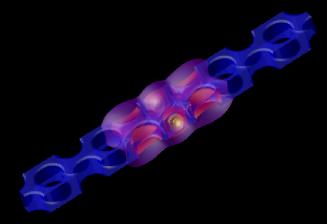
White-ray LEDs are actually made by blue LEDs: as the name implies, blue LED will generate blue rays. After YAG phosphor powder, these blue rays will transform into yellow rays. And the combination of blue rays and yellow rays (in a certain proportion) will create white rays. White-ray LED lights are widely used in various white lighting and backlighting applications. This type of white light was also defined as solid white lighting, having three major features: small size, energy saving, long service life. But compare with traditional fluorescent tubes, these lamps have a much lower lighting efficiency. Photonic crystals are an effective solution for this problem.


White-ray LEDs are actually made by blue LEDs: as the name implies, blue LED will generate blue rays.


In order to solve the low lighting efficiency of Blue-ray LEDs, scientists infused photonic crystals into Blue-ray LEDs to create a new compound: Photonic Crystal Blue-ray LED. Traditional manufacturing process of LED is rather simple. But the point is their low lighting efficiency. Because of the total reflection of the surface of traditional Blue-ray LEDs, rays came out from active layers will be totally reflected by the reflecting surface.


Aiming at this problem, CREE made some enhancements in the production process. A tiny slope beside the active layer can be seen in each deformed chip. Light efficiency can be dramatically improved by adding these slopes. Another improvement is designing a secondary set of product surface. Through this structure, scientists also can increase the light efficiency. Planar is a complicated and precise technique created to control this structure. Light pass through the secondary active layer, this structure can improve the light efficiency to 80%. However, it is in the case of reducing internal quantum efficiency. In order to address this problem, scientists installed Resonant Cavity on photonic crystal LEDs. This design was named as Resonant Cavity LED. Among these LEDs, scientists configured photonic crystals. This method can increase the light efficiency to around 60%.


Because of the diffraction, Photonic Crystal Blue-ray LED can revise the light angle. Some technical processes should be taken to convince that the revised light angle be smaller than the critical angle of used media. Restricted by the critical angle, normally only 4% light can be emitted. Relatively Photonic Crystal Blue-ray LED with active layer has a much wider emitting angle, having wider area to send out rays, can consequently have higher light efficiency.

How to produce LED chips by using photonic crystals LED

Photonic crystals have three chemical features, can be used in various areas through manual controls. 1) Block the light through optical energy gaps. Usually, technicians utilized this characteristic to lock light in a fairly narrow region, like integrated circuit. 2) The photonic crystal anisotropy of photonic crystals. Light emitted from photonic crystals will be scattered in different directions. Because the translucency of photonic crystals is variable with the polarization of the light. Thus the light transmitting and the light blocking occurred alternatively. 3) The curve of photonic crystals is complicated changeful. Because of the fast and irregular changes of photonic crystals curves, slightly changes in we light wavelength will cause huge angle shift of the input light. The biggest advantage of photonic crystals is that their size are much smaller than 1/1000 of integrated circuits. In another words, the integration will be 1000 times higher than before. Besides, the refraction coefficient will be 1000 times larger than more, as well.


Photonic crystals have three chemical features, can be used in various areas through manual controls.


Photonic crystals have other features. In fully use of these features can create photonic crystal LED. These LED lights can be divided into two major parts: (Light Emitting Diode) LED and Laser Diode (LD). LD can continued to be divided into Photonic crystal DFB LD and Photonic crystal defect LD. The DFB value of Photonic crystal DFB LD can be maintained in a rather low level to complete the lunch, with which we are very familiar. This structure must have optical energy gaps. It is very hard to achieve commercialization under such circumstance.


However, creating photonic crystals LED is much simpler. Some people may confuse this process with Photonic crystal DFB LD and consider of using specific frequency or wavelength and create photonic crystals LED. The answer is no. The incident and diffracted light of Photonic crystal DFB LD and Photonic crystal LD is limited. It is impossible to make use of certain frequencies or wavelength to enhance efficiency. This property is rather important for LED.


During the creating process of photonic crystals LED, scientists found that the application of transparent electrodes has litter effects on the final lighting efficiency. According to this result, scientists usually covered a tiny layer of transparent electrodes on photonic crystals. Use sapphire as substrates. And then create photonic crystals LED through MOCVD, EB and RIE ETCHING process.

Common sense of buying LED spot lighting products

The color temperature of the interior lighting can be divided into three groups: 1. Less than 3300K, which is also defined as Warm White. This soft light can make people a warm and comfort feeling, typically used in living rooms, bedrooms, wards, bars and restaurants. 2. 3300K-5300K, Natural White. This light is quite closed to the sunlight and has the highest CRI, suitable for working places and labs, like offices, classrooms, libraries, consulting rooms, laboratories, processing workshops, etc. 3. Larger than 5300K, Cool White. This color can provide the brightest light compared with the other two colors, mostly used in hot processing workshops and high illuminating places.


The color temperature of the interior lighting can be divided into three groups: 1. Less than 3300K, which is also defined as Warm White.


Usually LED spot lighting products are used as interior lighting devices. Thus their color temperature choices are concentrated on 2700K, 3000K, 4000K and 5700K. The “GB50034-2004 architectural lighting design standards” explicitly indicated that the CRI of lamps used in long-used working rooms/places should more than 80. In industrial construction sites with a light fixture mounting height more than 6m, CRI can be less than 80.


During the purchase of LED spot lighting products, costumers should carefully read the instructions and packing information provided by manufacturers, checking the input voltage and related production parameters. These parameters included luminous flux, color temperature, power consumption, CRI (color rendering index) and beam angle. This first thing need to be noticed is whether the LED spotlight can work under AC directly or need a transformer. Normally, LED spot lighting products have four bases: E27, E14, GU10 and MR16, in which MR16 based lights should work under DC (normally 12V). Secondly, customer need to check the light head and beam angle, comparing with their own requests. In the last step, customers need to choose suitable color temperature, CRI according to the “GB50034-2004 architectural lighting design standards” to achieve a reasonable lighting effect. If buyers had little or no acknowledge in light fixture’s parameters, they can check the equivalent marks on wraps. There will be some general estimation of what Watt traditional lamps can be replaced by this LED lighting products.


As for MR16 spotlights, which are usually equipped with an electronic transformer or frequency transformer, customers need to make sure the compatibility of them before purchasing the light. The incompatibility will cause flickers. As for spotlights with SCR dimming function, customers need to consider the compatibility between dimmer and lamps.

The standardized interfaces of LED spot lighting products

LED spot lighting products were mainly produced to replace the traditional halogen spotlights. Restricted by the traditional light shapes, light heads and installation methods, the design works of LED spot lamps are harder. Within the range of existing spotlights size standards, it is difficult to make these lamps in high power consumption and high luminous flux. In the mean time, there are other design difficulties in light distribution, heat dissipation, electrical security, etc. Under such circumstances, the properties of long service life, high lighting efficiency cannot be fully expressed, which exerted a negative effect on the healthy development of LED spot lighting products.


LED spot lighting products were mainly produced to replace the traditional halogen spotlights.


LED is a new lighting technology. LED spotlights are one of the oldest LED lighting applications. It is necessary to draw up a new set of interface standards for them in accordance with LEDs’ properties. Lay out explicitly terms for product dimensions, modular blocks, electrical and optical parameters and interfaces, realize the modularization and interchangeability of LED spot lighting products and promote the development.


Presently, the international ZHAGA Union attracted hundreds of manufactures and industry enterprises from lighting, lighting source and LED module fields. The majority of them are from North America, Asia and Europe. ZHAGA Union was committing themselves to improve the LED lights modules and the compatibility of controls within machinery, tests and parameters. A large number of relevant technical specifications have been published and modified for several times.


As LED technology matures, costs reduces, LED lighting products has acquired an initial popularity. A lot of LED lamps have been applied in various occasions. However, the development and popularization of LED spotlights still faced with problems. How to solve the cooling problem of LED spot lamps with high power consumption and high luminous flux? How to realize the modularization and interchangeability? How to fully present the advantages of LEDs: long service life, high lighting efficiency, controllable, etc. In order to solve the cooling problem and the power supplier problem, many producers will design lamp shapes without following the IEC 60630 standard.


As the main force of interior lighting applications, LED spot lighting products were responsible for making people’s life brighter and more colorful. Producing lights which are more cost-effective and more reliable still needs endeavors of LED manufacturers.

The growth rate of Russian LED lighting market will exceed 28%

In accordance with a recent research report published by Economic Research Center of Moscow University, the growth rate of Russian LED lighting market will exceed 28% in 2012. In fact, an increasing number of industrial giants (including Philips, NVC, OSRAM, etc.) put forward various marketing plans to exploit Russian LED lighting market. In their point of view, it is an emerging market with powerful potentials. In the mean while, experts concerned about the industrial competitions will destroy the early booming of this market. After a set of comprehensive researches, economists of Russian concluded two characteristics of their lighting market.


The growth rate of Russian LED lighting market will exceed 28%


1)       The fluorescent tube market of Russia had a large maintain volume, but lacking of advanced recycling technologies and facilities. The wasted lead and mercury of scrapped tube glass caused serious and long-term damages to environment. In order to figure out some effective solutions for this problem, experts suggested that some processing centers should be established, the number and size should refer to the capacity. For the reason of lacking of capital, the growth rate of selling is further exceeded to the growth rate of recycling. The environmental issue will become the “bottleneck” that block the development of fluorescent lighting products in the long run.

2)       The pursuit of profit has become one of the biggest obstacles of the market. The majority of Russian LED manufacturers competed for the lucrative professional lighting market, but paying much less attention to the mass energy-efficient lighting market. At the same time, the mass market had not been ready for a complete energy-saving-oriented transforming. Since Russian LED lighting market is an emerging market, ­­­most products sold in high prices. A standard LED lights cost 50 times more than ordinary incandescent lamps and 10-15 time more than fluorescent lamps, causing these products hardly be accepted by ordinary people. However, dealers did not take it seriously. They are more willing to concentrate on large public procurements of energy efficient lighting project, since these orders were mainly from buyers from public industries (like railway industry, chemical industry, electric power and oil industry, storage industry and public construction, etc.) who with “deep pockets”. Take Esi Waite Lanna photoelectric enterprise for example, this company have already signed more than 100 lighting contracts with Russian railway company.