
Recently, the Tokyo Metropolitan Government installed 39 garden lights using perovskite solar cells at Odaiba Seaside Park (Minato City, Tokyo) and two additional units at the Tokyo Metropolitan Government Building. A thin-film version of the same type of battery is expected to be installed at Harumi Passenger Ship Terminal around the summer of 2026, with a total capacity of approximately 50 kilowatts-currently the largest-scale installation of its kind in Japan. The initiative aims to accelerate the demonstration and practical application of such solar cells.
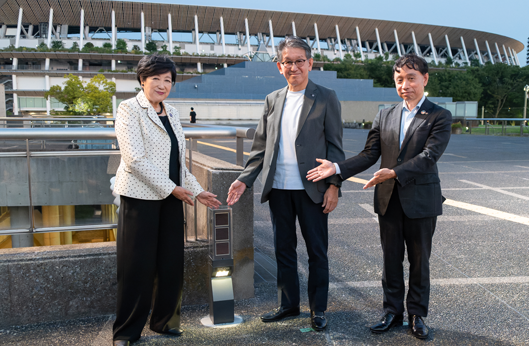
Previously, the metropolitan government installed 35 garden lights at Tokyo Metropolitan Gymnasium in August 2025 and conducted demonstration tests there until December of the same year. In this new demonstration, improved garden lights have been used, with their operating time extended from a maximum of eight hours to fourteen hours.
Since the previous demonstration confirmed that a certain amount of electricity can be generated even on cloudy or overcast days, it was decided to conduct further verification at the Tokyo Metropolitan Government Building, where sunlight exposure is relatively poor due to its location among high-rise buildings. The garden lights installed at Odaiba Seaside Park will be jointly verified with Ricoh to ensure nighttime illumination and promote decarbonization.
The installation project at Harumi Passenger Ship Terminal is scheduled to commence around the summer of 2026, and will be carried out in collaboration between Sekisui Solar Film Co., Ltd. (Kita-ku, Osaka) and Kyocera Communication Systems Co., Ltd. (Fushimi-ku, Kyoto).