More than 80% failure of LED products is from LED power suppliers

LED lighting market is fast growing, along with the rapid development of LED lighting industry. On one side, manufacturers for traditional light power supplies aggressively introduced new LED power suppliers or upgraded products for LED lights. On the other side, man entrepreneurial companies have been founded as well. However, the power technology is not mature yet. There is still no unified standard and the corresponding market is also in chaos. Relevant experts believe that LED lighting market will be finally dominated by a few giants. Marketing strategy an product quality is the key to the final victory.
 

More than 80% failure of LED products is from LED power suppliers


2012 is a mixed story for LED lighting industry. Market is growing fast. But not every participants earned money at last. Most of LED street light suppliers did not make any profits. Most of LED tunnel suppliers only earned enough money to cover all charges. Some LED commercial lighting application providers with strong trade ability actually made money. All LED chip makers and packaging factories, both domestic and overseas earned money in 2012.


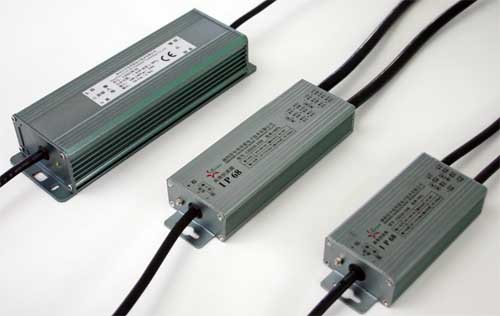
It is noticed that most manufacturers for LED power suppliers also had a good harvest in 2012. LED power suppliers are technically belong to the traditional electronics industry. Chinese manufacturers have strong manufacturing capabilities in this area. Although it is an emerging industry, price war has started in advance, especially in low-powered LED driver field. In fact, the price of small-powered LED drivers is very transparent, normally 24-25 yuan.


But LED drivers are still a highly profitable business. The relatively high technical threshold and large capital investment are major reasons. In addition, High-powered LED drivers are usually used in high-powered LED lighting applications, such like LED street lights, LED tunnel lights. These lamps are mainly used in government lighting projects and supported by government policies. Manufacturers will use best components and modules on their products to obtain a good effect, which will virtually increase the production cost at last.


According to incomplete statistics, about 80% failure of LED lighting products comes from LED power supplies. In recent years, with the continuous improvement of packaging technology and cooling technology, the stability of LED drivers has reached a satisfied level. The additional light attenuation and color shift all comes from the unreasonable cooling design.
The cooling section design for outdoor LED lights

Outdoor LED lights usually work in harsh and complex working environments: temperature, ultraviolet rays, humidity, rain, dust, chemical gases and other climate factors. All these factors combined can significantly affect the light attenuation of LED chips. Designers should take all these environmental factors into account when during the design of outdoor LED lights.


Outdoor LED lights usually work in harsh and complex working environments: temperature, ultraviolet rays, humidity, rain, dust, chemical gases and other climate factors.


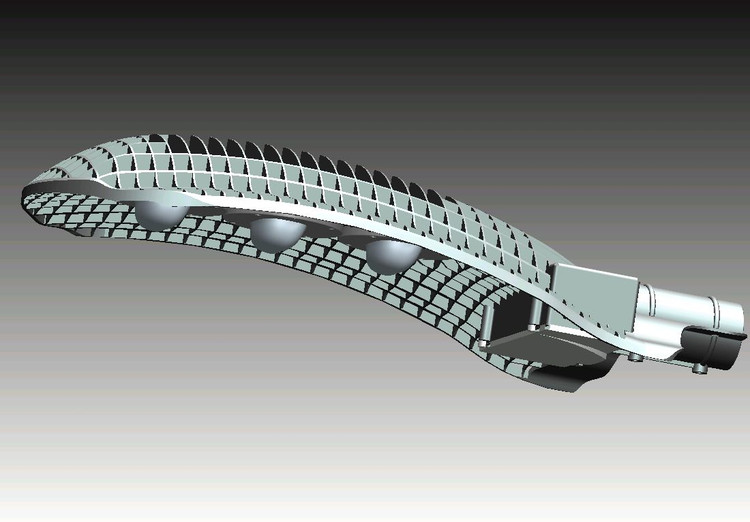
Shell and radiator designed as a whole to solve the LED cooling problem is an appropriate method. Normally, LED manufacturers prefer to use aluminum or aluminum alloy, copper or copper alloy and other alloys that with good thermal conductivity.


Radiator is a crucial part of LED lamps. The shape, size, heat dissipation surface area of it must be well designed. Small radiator will make the lamp work in high temperatures, affect the luminous efficiency and life time. Large radiator need to use a lot of materials, increase the cost and weight, declining the product competitiveness. Appropriate LED radiator design is essential. Radiator design has the following parts:

  1. Make clear of the cooling power that LED lights need.
  2. Some parameters that radiator design needed: specific heat of the metal, thermal conductivity of the metal, chi resistance, thermal resistance of heat sinks, thermal resistance of ambient air.
  3. Heat dissipation type: air convection radiator, strong wind cooling section, heat pipe, as well as other heat radiation ways. From the cost comparisons: air convection radiator cost least. Heat pipe and cooling jet cost the most.
  4. Make sure the maximum operating temperature (ambient temperature plus the permitted temperature rise)
  5. Calculate the volume of the cooling area. Determine the shape of radiator.
  6. Combine LED lamp body and radiator to a complete lighting fixture. Take simple indoor lighting tests: more than 8 hours constant work; at room temperature: 39℃–40℃. Calculate the average working temperature, see if it meets the cooling requirements. If normal condition is not met, related parameters are necessarily to be reset.
  7. Radiators and lampshades should be waterproof, dustproof. Rubber pad / rubber mat can be used between lampshade and radiator to prevent aging. Stainless steel bolts are used as waterproof / dustproof devices. By above four points, and plus related regulations for outdoor lighting applications and roadway lighting standards. All these are basic knowledge that outdoor lighting designers must be obtained.

Light attenuation solutions for LED roadway lighting products

In order to solve the serious light attenuation problem of LED roadway lighting products, LED street light manufacturers need to start with basic materials, solving the cooling problem from inside. For example, when light-emitting components stick with aluminum plates, heat conducting glue plays a rather important role. Some makers believe that heat conducting films and heat conducting pads have much better performance, the thicker the better. However, they do not take into account of the thermal resistance. In addition, heat conducting films or soft heat conducting pads actually cannot really fit the substrate surface. There are many pores, which is another form of thermal resistor. Under the interference of so many resistances, the heat conduction efficiency has been virtually reduced.


n order to solve the serious light attenuation problem of LED roadway lighting products,


It does not mean that LED makers should find other materials to take place of heat conducting glue. In fact, heat conducting glue is still the most suitable material in LED package. Right glue may have quite low thermal resistance, such like screen printed soft ceramic heat conducting glue (SPSCHCG), which is quite different from traditional paste-fit heat conducting glues. SPSCHCG is a type of soft semi-liquid material. When coat this material up on the aluminum plates, heat conducting particles will penetrate into the pores of the substrate surface and fill them to full to form a completely flat plane. Therefore the thermal resistance can be reduced to a minimum level, and the heat generated by LED roadway lighting products can be quickly conducted outwards. In addition, due to the good ductility of SPSCHCG, this material can expand and contract along with aluminum plates in the high temperature of baking and reflow. The stress is very small, will not cause a warp or burst of aluminum plates.


With the continuous improvement of packaging technology, carrier board design and cooing module structure, the production costs of LED roadway lighting products are also further reduced. But only a few Chinese manufacturers spent energy and money on the research and development of materials. In issues of solving technical problems and reducing costs, they are more in favor of purchasing. In this part, manufacturers from North America and Japan have much better performances. They are more like to find breakthroughs on basic materials, reducing production costs by innovations.

Analysis of the light attenuation of LED roadway lighting applications

Currently, the majority of LED roadway lighting applications face with serious light attenuation. This problem can only be fundamentally solved through the improvement of LED cooling technology. According to recent statistics, China has the highest growth rate in LED roadway lighting applications. It is predict that this dominating will be continued in 2013 in the global market. In 2012, the Chinese Ministry of Science and Technology issued a LED-lighting-related project: “Ten thousand lights in ten cities”. Although this implementation is a economic model that create the market demand via central government policies, but the response is not as good as expected.


Analysis of the light attenuation of LED roadway lighting applications


Lacking of unified LED standard is not the only reason for the huge gap between the market and policies, serious light attenuation of LED roadway lighting applications is another potential problem for this issue. The former unified standard will be possible programmed in the near future, while light attenuation problem still need to be solved via the improvement of cooling technology.


Temperature is the major element to accelerate the light attenuation. As a type of high-powered LED lighting applications, LED roadway lamps usually work in high temperatures. LED street lights have relatively high working temperatures than ordinary residential lamps. Thus LED manufacturers paid a large amount of energy and money on the development and design of heat dissipation substrates, sinks and other cooling models. After package, makers need to take painting process to keep cooling models away from climate erosion. Unexpectedly, the external protection seal back the heat generated by LED lamps, speeding up the light attenuation of them.


The heat generated by LED chips / LED light sources are a type of small ranged concentrated thermal energy. For high-powered LED roadway lighting applications, the high input power and the high interface temperature are also heat sources with lamp bodies. Working in high temperatures for a long time, if cooling models cannot effectively conduct all heat outwards, not only the service life and performances of LED lights will be affected, but also the light attenuation will be more serious. LED street lights are normally used outdoors, taken into account of the climate factor, most of manufacturers added anodized shell protections or spray paint on the surface of lamp bodies, which is definitely block the heat dissipation.

LED test: errors frequently happened

Usually, in LED test, luminous flux, CRI, color temperature and power deviation are four major aspects that with relatively high failure rates. Unqualified quality testing results mainly concentrate in four aspects: 1. Electrical insulation cannot meet the corresponding requirements: insufficient internal clearance and creepage distance, with touchable conductors (not safely isolated). Especially for some small sized LED lamps, the compact structure forced manufacturers to ignore the requirements of electrical insulation. 2. Using drivers that cannot meet the safety requirements of LED power supplies, or using simple buck circuit to drive LED lamps. 3. Electromagnetic disturbance voltage exceeds standards: most of LED drivers use cheap but weak circuits without any anti-electromagnetic measures, leading to conduction voltage and radiation exceeding. 4. Cannot meet the light and color performance requirements. LED light-emitting principles have huge differences with traditional lighting technologies. Many designers only concerned about whether their products can send out light normally, but ignore the quality of photometric and colorimetric requirements, resulting in the huge differences in color temperature deviation and low CRI.


Usually, in LED test, luminous flux, CRI, color temperature and power deviation are four major aspects that with relatively high failure rates.


In LED test, lamps from one manufacturer may get different testing results in different testing processes. There are three main reasons that cause to such situation:


1)       Testing system errors. This error is within the allowable range. Due to production process deviations, it is very hard for different testing system to stay exactly the same. There must be some errors. Traditional light fitting with error less than 1.5% are qualified. However, tests for LED lighting products have not been standardized. The permissible error range of LED lighting products is relatively vague, generally between 3% and 5%.


2)       Error comes from different testing environment. Lamps’ working environment along with the different surface contamination will exert huge influence on testing results, 7%-8% error. Especially for some products which used light-emitting surfaces as the secondary optical lens. These products have concave and convex structures. Dust and dirt can easily accumulate on the surface, hardly to clean up, which seriously affect the luminous flux and furthermore the light distribution.


3)       Errors come from equipment deviations and standard errors. Normal LED test includes: spherical integral devices, devices for light distribution measurement and equipments for light radiation. Spherical integral devices are used to measure the luminous flux of LED lights.

Advantages and selections of LED ceiling light

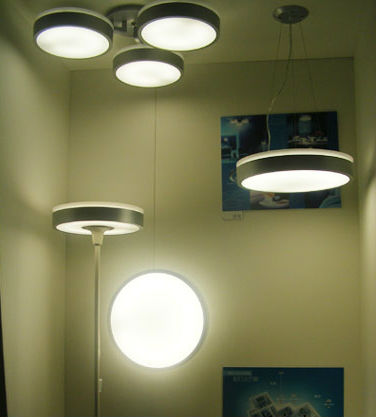
LED ceiling light use special process and G24 LED light source package, with higher luminous efficiency (120lm/W), better cooling effects, lower light attenuation (less than 3% after 3000-hour aging test), longer service life, safer, more durable and more reliable. LED ceiling light can be used in various conditions. Working temperature: -20 centigrade to 55 centigrade; working voltage: 12VDC/24VDC, 100-240VAC; Color: Cool White / Warm White / Natural White / Red / Yellow / Green / Blue / Multiple colors.


ED ceiling light use special process and LED light source package, with higher luminous efficiency (120lm/W),


Compared with traditional ceiling lamps, LED ceiling mounted lights are more advanced in: 1. Energy-saving; the power consumption of white-ray LED ceiling lamps is only 1/10 of incandescent lights and 1/4 of energy-saving lights, with the same output luminance. 2. Longer service life; the average lifetime of LED ceiling lamps can reach up to 100,000 hours, very suitable for residential applications; 3. Frequent turning on/off the power will cause damages to energy-saving lights. But this condition will not occur on LED lights. Due to their special working principles, all of LED-related lighting devices can work under high frequency. 4. LEDs are a type of cold light source, using solid package, easy to transport and install, can be embedded within small and closed equipments, with low heat generation.


How to choose suitable LED ceiling light? Are there any knacks?

Radiator: how fast a lamp can outwardly transfer the heat generated by LED chips determine the light attenuation speed and the service life of LED lights. Working in high temperatures for a long time will speed up the light attenuation of LED chips. Main cooling methods for LED ceiling lights are mainstream integral heat sink, single cooling column for single lamp bead, external fan cooling mode. The size of radiator along with the quality of aluminum material affect the heat dissipation and also selling prices.


Lamp drivers / power supplies: in fact, the lifetime of power supplies usually determine the lifetime of the entire lamp. For the reason that, compared with LED chips, power supplies are more likely to fail. Normally, LED chips can have a working life of 50,000 hours. The lifetime of most power supplies is far less than this value. electronic components, circuit designs and other factors together determine the power factor, power efficiency, reliability, temperature rise and lifetime of LED power supplies.

LED test: sampling test results are not optimistic

From the current LED product structure and developing direction, the main testing standards for LED-related lighting products are focus on optical performance, electrical performance, terminal conductivity, radiation safety and service life. Optical performance is mainly related to the luminous flux, radiant flux, luminous efficiency, chromaticity coordinates, correlated color temperature (CCT), color rendering index (CRI). Photoelectric detection, light distribution detection, light energy detection, attenuation and anti-vibration test are five major normal testing for G24 LED lighting products.


From the current LED product structure and developing direction, the main testing standards for LED-related lighting products are focus on optical performance, electrical performance, terminal conductivity, radiation safety and service life.


However, according to a recent sampling LED test report, results are not satisfied. Recently, the Guangdong Provincial Bureau of Quality Supervision issued a product quality supervision and inspection testing report for self-ballasted LED lighting products. The final results showed that among 23 self-ballasted LED lamps, 17 are unqualified. The failure rate is as high as 73.9%. Failure items include accidental contact with live parts, the wet processing insulation resistance and dielectric strength, mechanical strength, fault status, chromatically tolerances, general CRI, harassment voltage, lamp power, heat resistance, interchangeability, power factor, the initial light efficiency / luminous flux, anti-blame capability and so on.


Awful LED test results happened frequently in recent years. Tracing the source, lacking of standards and immature testing systems mainly contribute to the high failure rate of LED sampling tests.


Although routine performance tests need to be taken before products leaving factories, not all manufacturers will follow testing standards strictly. On one hand, the majority of LED manufacturers do not have complete testing equipments. On the other hand, they need to take cost into account. Current large LED enterprises have nationally recognized LED test laboratories and relatively complete testing equipments. SMEs usually conduct several small simple LED tests (maybe a few hours), also lacking of necessary testing equipments. These phenomena led to the high failure testing rate mentioned previously and consequently a great deal of negative impact in the LED lighting market.


CRI should be greater than 80, otherwise the initial luminous efficiency cannot meet the requirements of energy efficiency to reach the energy-saving effect. Currently, some LED suppliers blindly pursue high luminous efficiency but ignore the light attenuation and total lifetime of their products, leading to the low service life of LED lighting products and the high failure rate.

Intelligent control will increase the added value of commercial LED lighting products

Mr. Carlost LEE, the Secretary-General of the European Photovoltaic Industry Association expressed his views and questions in a recent published report of “When LED Enters Into the Third Development Cycle”: “It is expected that the general lighting industry will be explosively grow in 2018-2020. Certainly, the business model of the product should be combined with their life-cycle. G24 LED lighting products have relatively long life-cycle. Thus intelligent control will increase the added value of commercial LED lighting products.”


Intelligent control will increase the added value of commercial LED lighting products


LED lighting market is fragmented. Different application fields have different requirements to LED lamps. Take commercial LED lighting products and industrial LED lighting products for instance, the total production cost and appearance are two major factors that will be taken into account, while residential lighting products buyers are more concerned about qualities and lighting effects.


Currently, the penetration of automotive LED lighting products is still low. LED display industry has a relatively high market penetration. But we believe that the penetration of LED lighting applications in various areas will enjoy an increasing development from 2012 to 2020.


However, most of LED lighting products lack standard reference. Consumers are inclined to buy cheaper lamps but with low qualities, which will be easily failed after being put into service. This is one main reason why most buyers lost confidence in LED lighting products. It is not to say that every LED lamps should have a good quality. Good quality usually means expensive selling price. Consumers have right and should to know what type of products they are looking for. What kind of expectations that they should have on their products.


Incandescent replacing process is very simple. We now can see many CFL in hotels and hospitals as a replacement of incandescent lights. Generally, the service life of incandescent lights is around 6-9 years. Plus the good performance of CFL in lighting effects and luminous efficiency, it is very hard to persuade people to use commercial LED lighting products instead. LED makers need to put some additional value into their products to have them be accepted.


The lighting market is concerned more about the general lighting business. In order to further reduce the product cost, combining lighting technology, sensor technology, ITC and intelligent control together is a necessary developing step.

Intelligent control is the biggest advantage of LED roadway lighting applications

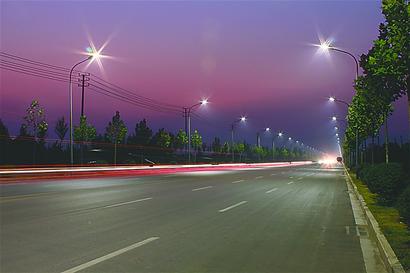
After decades of development, LED light source can send out high-brightness white light. The laboratory records for luminous efficiency reached up to 130lm/W, far exceeding the original 100lm/W. No matter in which way, G24 LED lighting technology is dramatically improved. High-powered white-ray LED lighting products have been widely used in general lighting applications, including LED roadway lighting applications. Compared with traditional road lamps, LED road lamps are more energy-saving and environmental friendly. However, as a new industry, LED roadway lighting still has many shortages. Service life and light attenuation are two main problems for high-powered white-ray LED road lamps.


Intelligent control is the biggest advantage of LED roadway lighting applications


To address this issue, Mr. Chunhai Wu, the technical director of the Shenzhen Lighting Environment Management Center suggested real conditions of 63 pieces LED street lights from 27 LED manufacturers in Shenzhen. From March 18th, 2009 to March 5th, 2011, in the case of normal daily using (normal switch on/off), there were 17 pieces lamps failed after two years, accounting for 27% of the total testing samples and 11 makers involved. Mr. Wu summarized: LED road lights’ aging tests should be performed on the ground (in factories, on production lines), and lighting attenuation tests should be finished in labs. LED road lamps are still weaker than traditional road lamps in stability. Certainly, different products from different manufacturers also have different qualities.


Mr. Haicong Zhang, chairman of the Shanghai Illuminating Engineering Society also affirmed the developing trend of LED roadway lighting industry. More advanced LED general lighting products have emerged in the lighting market in recent years. Through continuous improvement, these products are mature and stable. But LED road lighting products are still in the stage of immature.


According to Professor Lin Yandan from Lamps and Lighting Source Engineering Department of University of Fudan, LED road lights still have many advantages compared with high pressure sodium lamps. Intelligent control is their biggest advantages instead of energy saving. In order to satisfy large-scale applications, it is necessary to consider issues such as cost, reliability. If these problems are solved, LED street lighting industry will have a broader future.


With the continuous development of LED industry, LED street light industry will move toward the direction of specialization. The manufacture of LED lamps needs modularization. And also the modularization needs standardization.

LED beacon light start to emerge in the LED lighting market

Beacon light is a type of traffic lights installed in some beacon that ensure the safe navigation of ships and airplanes. They emit lights with particular colors and frequencies during the night, achieving particular irradiation angles and visual distances. Beacon light can be dived as fixed beacon, buoy, light boat and light house. Fixed beacons, buoys, light boats are usually used as navigation indicators or warming signals. Light houses issued identifiable signals day and night, helping ships to commit position measurements or also proving hazard warning information for ships.


Beacon light is a type of traffic lights installed in some beacon that ensure the safe navigation of ships and airplanes.


LED beacon light is a new application in the market, which has been greatly promoted and received a lot of attentions from maritime sectors. Choosing right LED beacon light and currently using it is rather important. Expect for planar LED light source directly used in guide beacons, bridge beacons and rotating lights, most of LED beacons are round applications. Currently, beacon manufacturers all over the world used mainly use two parameters to identify performances of LED beacon lamps: light intensity of emergent surface and vertical divergence angle.


Used as light sources, LED components normally have certain beam angles, ensuring the initial light intensity within a given viewing angle. The light intensity – viewing angle characteristic curves indicates that LED components are single directional rather than full angle range spot light sources. Therefore LED beacon light must use special lens.


For LED round beacons, LED is a special light source. G24 LED chip is equipped with a small optical lens. The general purpose of this lens is concentrating light emitted by spot LED light source into a beam with a certain solid angle. Suppose a LED component with a solid angle of 30°, most of the light will be concentrated within this angle. The light intensity will be rapidly reduced outside this range. LED round beacons are a type of beacon lamps that evenly arrange LED components (with a certain solid angles) on the circumference with a certain diameter. If saying that this circumference (fully filled with LED components) is called light-emitting circumference, the Philippines Cornell Lens typically designed for LED round beacons will concentrate the light emit by the light-emitting circumference. Here LED chips are no longer LED sources.