
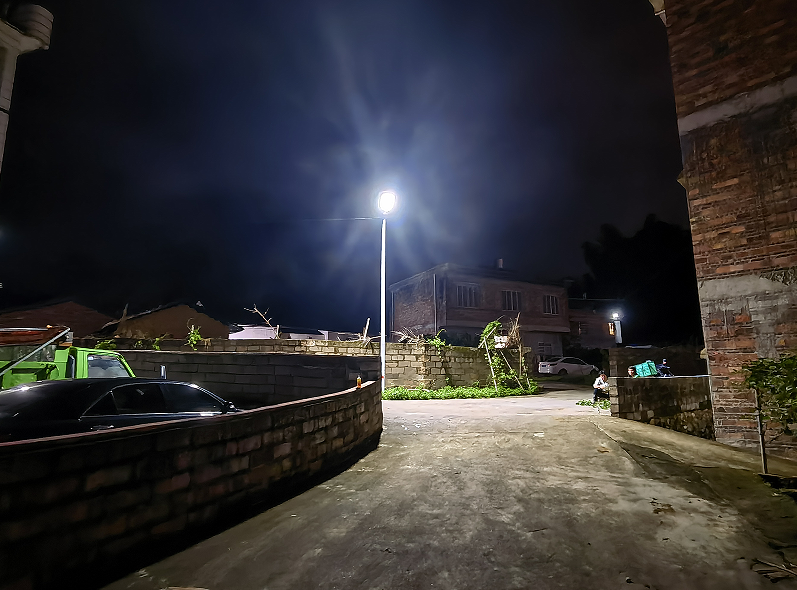
To implement urban renewal initiatives, improve the rural living environment, and effectively address villagers’ nighttime travel difficulties, on June 15, 2026, leveraging funds from the 2026 First Secretary’s Village Assistance Project, the village committee and village work team of Shangsi Village, Liantang Town, Babu District, Hezhou City, Guangxi Zhuang Autonomous Region, completed the replacement of 60 old solar streetlights in the village. The project successfully passed inspection, addressing the village’s lighting shortcomings through this small-scale public welfare project, ensuring bright lights at night and protecting villagers’ travel safety.
The original solar streetlights in Shangsi Village had been in use for many years. Due to years of weathering and natural aging, some lights suffered from damaged light sources, failure to illuminate at night, and insufficient brightness. These created numerous lighting blind spots in high-traffic areas such as the main roads and cultural square, affecting villagers’ evening walks and daily travel, and posing traffic safety hazards, becoming a pressing issue for villagers to resolve.
Focusing on the urgent needs and concerns of the villagers, the Shangsi Village Committee and the village-based work team promptly surveyed the operation of all streetlights in the village and precisely formulated a replacement plan. This project prioritized convenience for residents, focusing on key public areas such as the main roads, side roads at the village entrance, and the cultural square as the first replacement sites, eliminating lighting blind spots in core areas. To expedite construction and ensure safety during high-altitude operations, the project utilized aerial work platforms for dismantling and installation, significantly shortening the construction period and minimizing the impact on villagers’ daily travel.
The newly installed solar streetlights feature comprehensively optimized hardware configurations. Compared to the old models, they are equipped with larger photovoltaic panels and more LED chips, resulting in higher energy storage efficiency, stronger nighttime illumination, and longer battery life, further enhancing energy-saving and environmental performance. Furthermore, the lights adopt a universal compatibility design, compatible with both straight and curved poles within the village, eliminating the need to modify existing infrastructure and effectively saving on renovation costs, significantly improving adaptability and practicality.