Why solar roof performance lighting systems are difficult to promote(4)?

There are technical difficulties to be overcome

Let the sun gives us room direct “lighting” , how difficulty it is? Reporters learned, first of all, most of the buildings did not take into account the demand of solar panels installed that must make solar panels and building integrated ” in order to promote solar roof performance lighting system.

Why solar roof performance lighting systems are difficult to promote(4)

Shenzhen Yanion associated Chairman Zhou Min told reporters that, under the current conditions of the conversion efficiency of solar panels, building solar rooftop power station is low efficiency, the need take up a lot of building roofs resources, while the city’s buildings roof is very expensive and scarce, it is difficult to provide the construction of power stations to the laying of the space required by the solar panels; economic benefits low roof power station payback period is 40 years or more, while the average of the solar photovoltaic light is only 20 years, so the investment and return are not match.

Zhou take an example, for ordinary residents, most are living in high-rise buildings. With the restrictions of living space. So it is not easy for suitable place to place solar panels. Therefore, lost the place and opportunities in the installation of solar water heaters on the roof to install solar panels; Second, the 10 square meters of panels cost at least $ 56 million, the amount of electricity produced is not enough to meet the whole family needs. Future photovoltaic power generation combined with the building of the “photoelectric building” is the trend of the times, but in the current conditions, city residents use solar performance lighting system, the majority are pushing promotion in the public space.

Hope to further reduce the final cost

“Solar thermal is a strong industry policy,” Liu Xu said, many countries give subsidies for the introduction of solar energy industry, incentives. The reporter was informed that since March 2009, the Chinese government decided to allocate 100 billion yuan a year from the financial subsidies for solar photovoltaic roof and building construction, in order to promote the formation of domestic solar power market.

Solar companies can not rely on the financial support of the Government, and need to explore new business models to meet the user’s needs at the same time does not increase the burden on users, and to guide the led tunnel light market with innovative technology and product demand.

The plastic bulbs is expected to replace the LED lighting bulbs and become new light source?

According to foreign media reports, U.S. scientists have invented a plastic bulb that can issue very close to natural light, and very good stretch, no worry to fall. It is expected that the first batch of plastic bulb will enter the market in 2013.

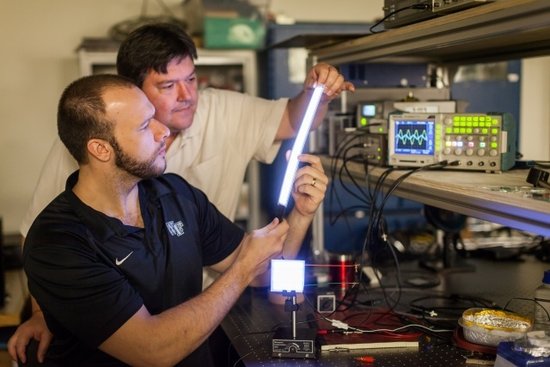
Wake Forest University scientists recently developed a new plastic bulb. The product has LED lights all the advantages, even more surprising is that this LED plastic bulb do not have any shortcomings. It has been reported that this plastic LED lighting bulbs are expected to replace a new light source. When current passes through the special plastic layer of this new type light bulb, it will emit light, this plastic layer is developed by using nanotechnology.

The plastic bulbs is expected to replace the LED lighting bulbs and become new light source?

The R & D team said this new type of plastic bulb has a very good stretch. It can be designed into various shapes, such as the present commonly used lamp rod-shaped. Users do not have to worry about this bulb that will shatter, and when  use it, it does not produce any noise.

This new lamp is temporarily referred to as “FIPEL”. The inventor David (David Carroll) Dr. Carroll said. It can win this new type of light bulb LED lights, but plastic is not particularly perfect bulb, the plastic may melt when the current is too high, which means the brightness of the plastic or restricted.

The emitted light of “FIPEL” is very close to natural light, but it vary greatly with the blue light emitted by LED street lights. Some people may worry about the plastic bulb life issues. Dr. Carroll said that his laboratory inside plastic bulb model has been used for nearly 10 years.

When asked about this plastic bulb that when to enter the market? Dr. Carroll said that a company is very interested in this product, and ready for mass production, it is expected to enter the market in 2013 the first batch of plastic lighting bulbs.

Solutions for LED chip display industry

Lighting, display, light source is three major applications for LED. Among them, LED display industry is the most mature one in terms of technology, product and market applications. Under the push of development law: technology progress and cost reduction. LED display industry chain can operate independently. In the past two years, as fund swarmed into LED upstream industry-LED chip display industry, manufacturers and makers began their crazy competitions for limited marketing resources. Below-cost sales occurred frequently. In the LED display market, despite that a few companies (display as their main business) are ready for listing, but there are also some LED display manufactures closed down. The economic crisis may be a factor, but the main reason is the limited resources but too intense competitions.


Lighting, display, light source is three major applications for LED.


In the LED display chain, LED chip display industry is the most important link. Chip manufacture should pay more attention on how to improve the quality of their products and how to use these chips correctly. The process features of LEDs determine the importance of testing. Testing should run through the entire LED industry chain.


The processing and packaging of LED chips should be divided into several levels in accordance with wavelength (light color), brightness, reverse voltage, leakage current and other related parameters. Electronic parameter detections are the same as detections for LED (light-emitting diodes). Detection for wavelength and brightness are relatively hard than other parameters, need professional sorters. Luminance colorimeter is typically used in display factories, testing the wavelength and evenness of brightness of LED Panel Light chips. However, this kind of equipment has problems in accuracy and calibration. Normally used luminance colorimeters, like BM-7, CL-100, can reach a precision of three digitals after decimal point, which is not sufficient for wavelength measurement. Thus LED chips from different production processes will be hard to mix-use.


For commonly used LED screens, brightness variations less than 10% can hardly detected by human eyes, and color variations less than 4nm can hardly detected, neither. So that, the general classification standard for normal LED chips is brightness variations less than 20% and color variations less than 5nm. Brightness/color changes within this range will provide relatively ideal effects. For LED modules, brightness variations less than 3% and color variations less than 2nm can hardly detected by human eyes. Thus modules’ mix-usage has much strict requirements than LED chips’ mix-usage. Normally, producers need to take chrominance and luminance calibrations.

LED lightings are going to mature and custom market worth to wait

The latest market information show that the retail price for LED bulbs have dropped to $ 8, while the price of energy-saving fluorescent lamps is about $ 5, consumers choose more energy-efficient LED lights. The tendency will further enhanced. It expected that in 2015 will truly usher in the take-off of the LED lighting market.

LED lightings are going to mature and custom market worth to wait

At the same time, the industry believes that the LED entering into the general lighting market rate may exceed people’s expectations. CR PowTech party movement analysis Road Technology Co., Ltd. General Manager said: “With the dramatic fall in prices of led lightings products, home application market is about to take off, the market is expected to grow around 30%, but I think it is far more, especially growth of LED application market of Chinese mainland may be doubled, LED lights factory price has dropped to $ 1.38, no price barriers to enter the home market, there will be some consumers who may try to use LED lighting products in 2013, if the trial down to good effect, in 2014, there will be a large number of procurement.

LED lighting is a big market for all semiconductor manufacturers, so it can not be ignored. The past, because of funding and lack of the ability of design, it has restricted the local chip design, companies enter into a certain system of chip market, and also led to the standardization of product market competition more  intense, gross margin decline continuously; and for the specific application of custom chips, also it is the area of the ASIC chip market that the Maori is relatively high, the whole 2011 analog chips market size of about US $40 million, of which more than 90% is a custom chip market. Therefore, for the specific application of custom chips, it has become one of the main directions of the world’s many chip manufacturers development.

Needing for led lightings special needs, chip manufacturers have more long-term development planning, as well as a strong ability to design, improve service, and in-depth client, real customers solve problems and provide practical solution sand products.

China is becoming a major global LED products manufacturing base, maturing critical period in LED lighting, customized semiconductor chip solid technical support will be provided for the universal application of led lightings products, and will also promote China’s LED Panel Light industry chain overall development and improvement.

“Spring-8”: new analysis material for OLED lighting manufacturing

The normal OLED lighting manufacturing methods (also known as organic EL lighting) are vapor deposition and coating method. Furthermore, even using coating method, there is still one type of operation that using similar materials and structures as vapor deposition. Another operation use materials and structures that typical for coating method. Different LED enterprises may choose different manufacturing process. KONICA MINOLTA ADVANCED LAYERS applied the former, while Sumitomo Chemical chose the latter.


"Spring-8": new analysis material for OLED lighting manufacturing


According to related reports of KONICA MINOLTA ADVANCED LAYERS, they have obtained great progress in recent researches and developments. “We have dramatically improved the yield of emitting layers, which had really low rate of production. They have much similar qualities with vapor deposition products. ” suggested by Tsuji Takatoshi, the general manager of OLED marketing center of this company. In the meanwhile, by using the large radiation-ray facility “Spring-8”, research groups of KONICA MINOLTA ADVANCED LAYERS analyzed the detailed internal structure, finding reasons for solidifications. Sumitomo Chemical applied a totally different OLED lighting manufacturing solution: a polymer material with multiple functions. They intend to head for the direction of simplified element structures.


There are some other makers (Mitsubishi Chemical and Pioneer) developed other methods that focused on color confusion, producing EL lighting components with display functions. Similar to display technology, this method can realize full color display (on one panel) via coating red (R), green (G) and blue (B) phosphor powders on light-emitting layers.


Showa Denko also developed their new OLED lighting manufacturing technology: using a completely different component structure – “COLED (cavity organic light emitting diodes), which is developed with SRI International, USA.”. i.e. do uneven process on the surface of glass bases, and add material depositions. Expect for a target of 150lm/W by 2015, Showa Denko did not reveal any detailed information about their studies. The current luminous efficiency of organic EL lighting components is around 30lm/W. Even so, Showa Denko still have full confidence on the development of COLED. “In the competitions with other large LED Panel Light enterprises, COLED is a powerful weapon. It is not surprise to hear that products from other companies have reached up to 128lm/W. We believe that COLED will have better performance in luminous efficiency.” said Suzuki Guangzhi, director of Electric Research and Development Section of Showa Denko.

Forced promotion of LED lighting industry will spoil it by excessive enthusiasm

After the draft “the promotion and popularization of LED lighting applications in Guangdong Province” released by the Guangdong Government, many local governments (like Dongguan, Shenzhen, Taishan, Shantou, Zhongshan, ect.) in Guangdong Province put forward their developing plan for LED lighting industry successfully. In addition, Hubei, Tianjin, Zhejiang, Hebei also promoted similar government-support policies in this area. The launch of these support policies was treated as a boost of domestic LED lighting industry. However, after a period of applauses and cheers, some people started to doubt the feasibility of such forced promotion.


Forced promotion of LED lighting industry will spoil it by excessive enthusiasm


Regional replacing technology is not mature, plus LED lighting industry is still in the early stage, lacking of core technologies and standards. It is hard to avoid suspicions of the feasibility of government support policies. What is more critical, the producing of LED products needs a lot of non-ferrous metal resources, which is actually violate the energy-saving, low-carbon, environmental protection concept. Abiding by the law, ignore the critical lighting efficiency, rely on relationships, have become unspoken rules of domestic lighting industry. If this phenomenon is rectified as soon as possible, the economy will suffer even greater losses.


Whether LED lighting business should be promoted forcedly? About this issue, people have different opinions. As the fourth generation lighting source, LED has obvious advantages: low-carbon and energy-saving. Clearly, LED will take place of other traditional lamps in the future.


Firstly, LED lighting applications can reduce the power consumption and consequently reduce the carbon dioxide emissions. Secondly, LED has very limited influences on environment, nearly zero pollution. It is understand that the popularization of LED Panel Light products is significant for the sustainable development of our country. In accordance with the current situation, the popularity of LED lighting products is still very low. Due to their over-expensive selling prices, they are hardly accepted by common users. Thus promoting is necessary.


LED is bound to replace traditional lamps, plus the promotion is also necessary. Does all these mean force promotions necessary? The answer is no. The popularization of LED should not only take into account of the trend of development, but also follow the law of development. Presently, a large number of domestic LED companies still in the immature stage, forced promotion of LED products will spoil them.


The invention of LED lighting modules set off the terminal light revolution

On November 21 of 2012, the Chinese Ministry of Industry issued a draft “Roadmap of gradually reducing the mercury content of fluorescent lamps”. According to this report, from June 1st of 2013, the China Government will start to decline the mercury content of fluorescent lamps gradually. The energy-saving lighting industry is facing up a reshuffle. Incandescent lights have been implemented the death penalty. Fluorescent lamps are facing the final examination. LED lighting applications have unlimited prospects and potentials. The 3rd lighting revolution has already opened the curtain.


The invention of LED lighting modules set off the terminal light revolution


In the 3rd lighting revolution, since standards were usually lag behind the development of the lighting industry, LED lighting applications have wide varieties and different performances, normally unchangeable. In another word, LED products from one manufacture (from one region) can hardly be replaced by LED products from other makers (from other regions). Due to lacking commonality and compatibility among LED lighting modules, the popularization of LED lighting products become even more difficult. More importantly, for manufacturers, low commonality and compatibility will increase the production cost. There are too many LED applications and too many standards and parameters for LED lighting modules. They have either limited their product range or increased their production. Commonly used compartments and equipments benefit LED makers a lot – reducing time for development and research, reducing development risks, reducing inventory and management costs, reducing the complexity of the production line and increasing production capacity.


Therefore, a joint development and promotion project for LED lighting module standards came into being at the beginning of this year. This project was led by the Science and Technology Department of Guangdong Province, under the guidance of the National Semiconductor Lighting product Industry Alliance and the Semiconductor Lighting Innovation Center of Guangdong Province, joined by other research organizations, universities and institutes. Guangdong is the largest “production base” for LED products. In the organization and implement of LED lighting module research and development, a large number of LED manufacturers and research institutes can provide good software facilities and hardware facilities.


In the long history of light sources, LED is just a new generation of light source and will not bring more impact that fluorescent lamps and metal halide lamps did. However, in the microscopic point of view, the innovation of LED lighting modules will speed up the development of LED lighting applications and bring the final revolution in the lighting industry.

How to solve the glare and spot problem of LED fluorescent tubes

In recent years, the enhancement of public awareness of energy conservation along with the rapid development of LED technology, to some extent, promoted the initial formation of LED lighting market. This booming trend is still going forward at an amazing speed. However, LED lamps in the market still have wicked problems: the glare and spot problem and single direction problem. These problems are more obvious among LED fluorescent tubes.


How to solve the glare and spot problem of LED fluorescent tubes


Many LED Panel Light manufacturers put forward various solutions to solve the glare problem of LED lighting applications: using brushed PC covers, frosted covers, using special phosphor materials, etc.. But neither of them is satisfied. In spite that brushed PC covers could remove glare effects effectively, they exacerbate the spot phenomenon, making things even worse. Working long time under such LED fluorescent tubes will tried your eyes, even worse cause astigmatism. Frosted covers and special phosphor materials will reduce the luminous efficiency dramatically, which is inadvisable in large lighting projects.


LED lighting market is full of potentials and opportunities. In the first stage (initial formation stage), insiders concerned more about luminous efficiency, luminous flux and lifetime of LED lighting fixtures, and of course the comfort.


However, after applying optical diaphragm, single light source became brighter but not dazzling. This type of diaphragm is typically used on LED fluorescent tubes, making the light distribution more evenly and the beam angle wider. The working principle is converting uneven spot light sources into evenly distributed surface light source, and meanwhile solving the glare problem, spot problem and beam angle range problem. The transmittance rate of this type of diaphragm is more than 90%, having very limited impacts on luminance.


In addition, using optical diaphragm can widen the irradiation angle as well as eliminate spot phenomenon. LED has very strong directional properties, with beam angle around 120 degrees. Theoretically, this range will cause blind spots. Using assisted diaphragm can enlarge the beam angle range to 180 degrees, eliminating blind spot phenomenon effectively. Within a certain space, LED fluorescent tubes with diaphragm have much better lighting effects than ordinary tubes, since they have no blind spots and unevenly distributed light. The larger the area, the better the lighting effect.

Five major critical points of the LED lighting industry

Local protectionism in support policies:

LED has been developed more than 20 years in China. Each year, the China Government (related departments or sectors) would launch a series of LED-related support policies and projects. Also many local governments will introduce policies to nurture local LED lighting companies, giving priority to the local LED manufactures in large municipal landscape lighting projects and traffic lighting projects. Thus most of LED Panel Light companies paid most of their attentions on participation in biddings/tenders of government projects. Besides, domestic LED lighting industry has no unified standards for LED electronic and optical parameters. Different regions have their own standards. It is very hard for LED companies to exploit markets in other regions, blocking the development of the LED lighting industry.


Each year, the China Government (related departments or sectors) would launch a series of LED-related support policies and projects.


Lacking of brand awareness;

There are a large number of LED makers. Most of them lack of independent brand, which disordered the market. Different products from different companies have quite different qualities. Unauthorized patent using and infringement happened frequently.


Civilian LED lighting applications needs the government support urgently;

Normally, LED lighting fixtures (like LED bulbs, LED flood lights) are more expensive than other traditional lighting products. The expensive upfront investment shakes the resolve of governments to support civilian LED lighting applications. So that the promotion of indoor (residential) LED lighting fixtures is much slower than other western countries. Currently, most of lighting associations (from different provinces and regions) are positively in response to the government support. But the more than 80% are municipal landscape lighting projects and traffic lighting projects, much less LED lighting products were used in civilian applications.


Bottlenecks of technology and equipment;

In the aspect of LED substrate technology and wafer production equipment, domestic LED lighting industry is obviously in a bottleneck stage. Most of independent innovations and patens are concentrated in the package area. Some critical core technologies, like white-ray LED, the heat dissipation of high-powered LED lighting fixtures, durable and efficient phosphor technology, are unfortunately controlled by larger foreign companies, mainly from Europe, North America and Japan. Domestic LED products still lag behind the international level in many respects: luminous efficiency, antistatic ability, anti-leakage ability and quality control.


Lacking of pricing power;

The majority of domestic LED companies are relatively small. The scattered and limited resources hindered the development of the LED lighting industry. Also relying on importation in the upstream LED chip area made domestic LED companies lose the pricing power.

The heat dissipation problem of LED chips cannot be solved easily

In the last few years, LED manufacturers positively develop high-brightness LED chips, treating the corresponding market as full of potentials and opportunities. The basic concept is enabling LEDs to work under high current to generate brighter light. According to current specifications, a LED chip with an area of 30um2 can withstand the maximum current of 30mA, which cannot meet the requirements of having LEDs generate larger luminance. In accordance with the expectation of the market, a LED chip with an area of 1mm2 can withstand the maximum current of 350mA. So that single-chip LEDs could generate higher internal quantum efficiency. Supposed the driver current is 3 volts, after calculation, there will be nearly 1W power that flow into LED chips every second.


The heat dissipation problem of LED chips cannot be solved easily


However, simply increasing the current cannot solve the problem fundamentally. Normally, about 3/4 inflow electricity will be wasted and convert into thermal energy. In another word, only 1/4 (0.25W) electrical energy will convert into optical energy. Troubles caused by the thermal effect usually exerted bad influence on LED lighting applications. LEDs will change the wavelength with the variation working temperature. Working in high temperature for a long time will reduce the luminous efficiency and CRI.


Theoretically, if the luminous efficiency of blue-ray LED chips can reach up to 360lm/W, along with high-level packing capabilities, it is not really difficult to obtain a 100lm/W white-ray output. It would not be a big issue with today’s LED technology. Many large international LED manufacturers have successfully developed high-brightness blue-ray LED chips, including CREE and Nichia. Now the really bottleneck is how effectively reduce the external quantum efficiency loss, which will test the ability of packaging industry.


On the other hand, the thermal effect caused by the increasing of input current is a very serious problem that needs to be solved urgently. Basically, reducing thermal impedance and improving heat dissipation is a generally direction for designers and producers. The current solution is reducing the thermal impedance of LED Panel Light chips, limiting the thermal impedance of control modules and printed circuit boards, increasing the heat dissipation effect of LEDs. Typically, manufacturers tend to choose materials with lower thermal impedance and good thermal conductivity. But in the mean time, size and weight are also two important factors that need to be taken into account.