LED intelligent lighting system changes classroom lighting environment

In recent years, the country’s investment in basic education has been increasing, but the number of myopic students in primary and secondary schools has increased rapidly. The survey found that poor classroom lighting environment is one of the main reasons for the decline of students’ eyesight.

LED intelligent lighting system changes classroom lighting environment

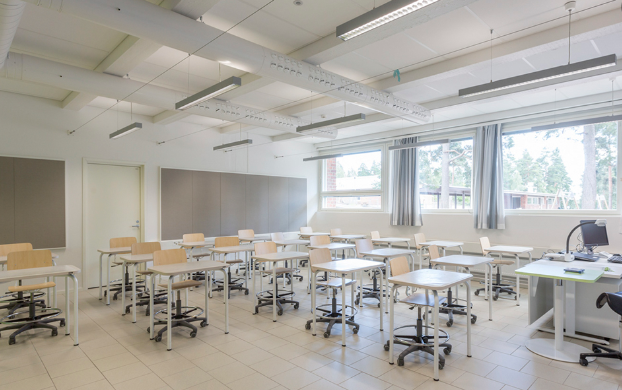
At present, most of the classroom lighting in primary and secondary schools in China use fluorescent lamps as light sources, or directly use the “lamp support (including electrical components) + bare lamps”, or use “lamps (grid lamp panel/blackboard lamp ) + Fluorescent tube light source method. Most of this type of lighting has the problems of generally insufficient desk illumination, poor uniformity of blackboard lighting, obvious glare easily irritating eyes, and high color temperature easily causing visual fatigue.

Primary and elementary schools, as a place where students live and study for a long time, a healthy light environment plays a positive role in promoting the growth of primary and middle school students.

The LED intelligent lighting system can meet the requirements of all standard contrast and uniformity of classroom lighting. When the total luminous flux of each lamp panel of the three-dimensional lighting LED lamp panel is 3000lm, it is at a level of 0.75m (lesson table height) 7.0m X5.6m The desk area of the student’s class, the illuminance maintenance value (maintenance factor is 0.8) is 336lx, and the illuminance uniformity can be 0.82. The three-dimensional lighting LED lamp panel with increased side and backlighting has a good performance in increasing the uniformity of the three-dimensional space and reducing the glare effect in the space.

Shanghai local standard “Code for design of classroom lighting in primary and secondary schools and kindergartens” was released

The newly revised Shanghai Local Standard DB31 / T 539-2020 “Code for Lighting Design of Primary and Secondary Schools and Kindergarten Classrooms” was approved by the Shanghai Municipal Market Supervision and Administration Bureau and will be released on February 28, 2020, and will be on May 1, 2020 Implementation, when the new version of the standard DB31 / T 539-2020 replaces the old version of the standard DB31 / T 539-2011.
Shanghai local standard "Code for design of classroom lighting in primary and secondary schools and kindergartens" was released

This standard is under the jurisdiction of the Shanghai Education Commission Education Technology Equipment Center. The drafting units include Shanghai Education Commission Education Technology Equipment Center, Fudan University Electric Light Source Institute, National Lamp Quality Supervision, and Inspection Center, National Electric Light Source Quality Supervision and Inspection Center (Shanghai).

The main differences between the new version and the old version are as follows:

1. Added the relevant requirements for LED classroom lighting fixtures. There is no requirement for LED lamps in DB31 / T 539-2011. In recent years, LED lamps have developed rapidly and have been widely used in many occasions, but in the education industry, they cannot be promoted because of backward standards. In this revision, the requirements of LED classroom lighting products are clearly defined. According to the characteristics of this product, strict restrictions are placed on blue light hazards, stroboscopic and flashing, lamp reliability, color rendering, and lighting power density. It will not harm students during use.

2. In order to improve the comfort of classroom lighting, a series of new requirements have been added on the basis of the original standard limits. For example, according to the latest lighting standards at home and abroad, color temperature and other indicators are added. For some places, vertical illuminance is increased, and two levels of basic and recommended lighting indicators are given; the technical requirements of LED classroom lighting products are increased, and light is proposed. Specific indicators of biological hazards; recommended indicators with certain leading values such as intelligent control have been added.

3. In view of the characteristics of children’s eyes, a special section for kindergarten lighting was added to clarify the lighting requirements for all kinds of activity rooms in kindergartens.

4. Based on the national standard GB / T 5700-2008, the test method of classroom lighting is clarified. The method specified in GB / T 5700-2008 is relatively loose and does not match the high limit requirements in the standard. Different testing institutions use different methods in the testing process, resulting in different test results in the same classroom. In order to avoid the above situation, in this revision, the test area, test interval, and test point selection of the classroom have made clear regulations.

5. In order to ensure that the classroom lighting continues to meet the requirements of the standard, the daily maintenance, maintenance, regular testing and service life of classroom lighting products have been specially formulated accordingly. It is required that classroom lighting of newly built, rebuilt and expanded classrooms should be inspected by qualified third-party testing institutions at provincial level and above before the official opening. The testing items should include at least the desk illumination and uniformity, the writing board surface illumination and Uniformity, glare (UGR), lighting power density, color temperature and color rendering index, etc .; also provides for regular maintenance and update of damaged and defective light sources and lamps. When the light source or lamp cannot meet the requirements due to light attenuation, the light source or lamp should be replaced in time; the surface of the lighting device should be cleaned every semester. Every semester the school should conduct re-testing of classroom lighting and so on.

The promulgation of this standard will lead Shanghai primary and secondary schools and kindergartens to further establish a healthy, comfortable and advanced classroom light environment, and provide support for the effective control of students’ poor eyesight rate.

LED Smart lighting strategy starts

Whether or not you consider implementing an intelligent lighting system based on the Internet of Things, it is also wise to evaluate the most basic element of the lighting strategy: light bulbs. Incandescent bulbs are still widely used, but with the advent of LEDs, this situation is changing.

LED Smart lighting strategy starts

Essentially, LED bulbs produce more light than traditional bulbs. When they were first launched, they emitted more “cold” white light. Today, they can provide the same natural “warm” light as incandescent lamps.

Many companies around the world have turned to LEDs, which can be easily installed in existing lighting in most commercial buildings. The reason for their installation is that LEDs are up to 75% more energy-efficient than incandescent bulbs, lamp life is also more than 25 times longer than incandescent bulbs, and generally produce better light quality than incandescent bulbs. In addition to cost savings in energy use, many power companies also provide energy-saving subsidies as an incentive for companies to transform LEDs. Lighting retrofits are generally considered to be the easiest to achieve results because they can immediately and easily help significantly reduce energy consumption.

LED lighting is not only suitable for office buildings, but also for almost all other types of commercial facilities:

Warehouse and industrial environment: Large places like this benefit from LED lighting, because they consume less energy, and LED lights can emit light in a specific direction (unlike incandescent and fluorescent lights).

Indoor farms: Some high-tech farms around the world are using LED lights to optimize plant growth. They do this by customizing light “recipes” and can affect how plants grow and their taste.

Commercial parking lot: For safety purposes, in indoor and outdoor parking facilities, the quality of lighting is critical. In addition to saving money, safety is also one of the reasons why parking lot lighting has become the fastest growing LED commercial lighting market.

Health care facilities: Part of the design of health care facilities is for patient comfort. LED lighting helps create ideal light output for the environment while improving efficiency.

Correctional facilities: Correctional facilities have various lighting needs, from prison cells and activity rooms to lounges and corridors. LED lights do not interfere with the safety and camera, they can maintain a uniform, high-quality light, thereby improving visibility.

Educational facilities: LED lights are ideal for schools with limited budgets, and the energy savings can be reused for technology and other educational resources.

Retail facilities: More and more retailers are using LED lighting to add aesthetic and visual appeal to their stores, thereby creating an excellent shopping experience. Proper in-store lighting can increase sales.

Because LED lights are naturally friendly to digital control, they are very suitable for IoT applications. IoT LED lighting is the ideal way to achieve maximum savings and gain valuable operational insights that can improve all aspects of your building management.

China LED lights are popular in India

“Indian businessmen are constantly looking at the products and have already squeezed my booth,” Ms. Chen, who participated in the India LED Products Exhibition, lamented that although she was exhausted every day, orders from many large Indian customers were still Make her excited.

China LED lights are popular in India

The efficient lighting plan promoted by the Modi government in India has activated the huge potential of the LED market. To save lighting costs, India plans to provide 770 million LED bulbs to the public by 2018.

Since Indian LED products are mainly imported, a considerable part of them come from China. This efficient lighting plan has created huge business opportunities for Chinese LED manufacturers in India.

To understand the popularity of Chinese LED products in India, the reporter specifically visited the 2015 largest LED products and technology exhibition in India, which was held in New Delhi earlier this month.

Chinese companies account for one-third of the more than 200 exhibitors. The LED products on display include materials, chips, equipment, packaging, and lighting accessories, covering the entire LED industry chain. The reporter saw that almost every Chinese booth will be consulted by many Indian businessmen.

Ms. Chen’s Shenzhen Mingyang company mainly provides LED lighting kits for Indian lighting companies participating in government procurement, BAJAJ Electric Company and Indian IT giant Vipro. The head of Mingyang Company’s office in India told reporters that since the Modi government promoted the replacement of incandescent lamps with LED bulbs, orders began to increase steadily.

Chinese LED products enjoy the reputation of “cheap and good quality” in India. Gulabchand Haria is a businessman who does wholesale business in Mumbai and has also visited LED exhibitions in New Delhi. Haria said: “I mainly want to order LED lights from Chinese manufacturers. Although I also operate products provided by Indian suppliers, the price is more expensive than Chinese products, so the sales are not good. So I still hope to sell Chinese goods.”

The reporter saw many Indians asking about a product developed by the Chinese Academy of Sciences for driving LED lamps at the booth of Ms. Chen. Ms. Chen told reporters: “This kind of product is specially designed by experts from the Chinese Academy of Sciences according to the unstable voltage in India. Installing this kind of driver can avoid the damage to the bulb caused by the sudden voltage increase.”

Ms. Chen said that the price of this new product of the Chinese Academy of Sciences is only half of the current ordinary lamp driver on the market, but most Indian customers are still stuck in the product consulting and testing stage. After the product is approved by the market in the future, Indian customers will save half the cost. This is really “cheap and good.”

At the exhibition, the reporter saw a mandatory product registration system table issued by the Delhi test laboratory officially approved by India, which proposed many new standards for LED lighting systems related to products such as TVs, mobile phones, cash registers, and plotters. .

An industry source told reporters: “Although this can be seen as a way for the Indian government to restrict Chinese LED products, it warns Chinese manufacturers that they need to work harder to improve product quality.”

Solar street lights help Spanish city Seville improve urban safety

Recently, Xin Nuofei announced the use of solar lighting equipment to help Seville Elena Park enhance the safety of visitors. In this pilot project, Elena Park will install 20 sets of Philips Sun Stay solar street lights to jointly implement the environmental sustainability of Seville and Xin Nuofei.

Solar street lights help Spanish city Seville improve urban safety

Philips Sun Stay solar street lights integrate solar panels, lighting originals, charge controllers, and batteries in the same device, which makes it quite compact and easy to install and maintain. In addition, it will also help Seville, which adheres to environmental protection and sustainable development, reduce energy consumption, and carbon footprint.

Juan Espadasi, Mayor of Seville, said: “As a leading city in environmental protection development, Seville has always insisted on combating climate change, and its environmental protection philosophy is also in line with the 2030 Seville urban strategy and the United Nations Sustainable Development Goals. At the moment, all municipal power in Seville is 100% renewable energy. This is precisely the importance of creating green spaces in the city. This innovative commercial project can help increase the use of public space for citizens At the same time reduce emissions and achieve sustainable development. ”

Philips Sun Stay solar street lights can help reduce wiring costs and carbon footprint and reduce overall capital investment and operating expenses. Philips Sun Stay solar street light has a warm light output of 3,000lm and a luminous flux of up to 175lm per watt, which is currently the most efficient solar street light on the market.

After installing the Philips Sun Stay solar street lamp, high-quality lighting allows people to participate in more outdoor sports at night, and also makes the surrounding residents and tourists better use the city’s green public space.

“We are very happy to see the application of solar lighting in European cities.” Harsh Chitale, general manager of Xin Nuofei’s professional lighting business department, said in an interview, “I am very confident that in the future more and more European cities will The installation of solar street lighting will help fulfill our expectations of strong business development in the market segment in the coming year. ”

The new lighting system was installed in June this year. Compared with traditional lighting systems, solar street lights require less time to install. This is due to the fact that its installation project does not involve pipeline installation and other infrastructure transformation, and the input cost is less and the impact on local residents is also smaller.

This pilot project in Seville is another practice of Xin Nuofei on the concept of sustainable development. Xin Nuofei always adheres to the environmental protection commitment of “shiny life, beautiful world” and is committed to providing consumers with more efficient and energy-saving light sources and improving their quality of life. As an important part of the environmental protection commitment, Xin Nuofei has reached a carbon-neutral operation in Spain in 2017.